A few weeks ago Maya Paris suggested that I apply to put Split Screen onto the SL Destination Guide. Lo and behold, it got in. The effect was phenomenal: over 400 visitors in the first five days. Traffic subsided soon after but remained far higher than before. Judging from their names, many of which ended in "Resident," and also the behavior of a few I observed, a large portion of the visitors were newbies. Someone insisted to me that newbies never go to see art so they must all be alts; possibly this person was joking (didn't sound like it), but that seems unlikely. After all, there's no particular reason for someone to come to see art as an alt, it's not that shameful! Plus one would expect established residents interested in the arts to visit in response to the notices I sent to various arts groups. So it looks like (1) many people actually use the SL Destination Guide (I hardly ever have); and (2) many newbies are in fact interested in art, or at least curious about it. This is great news!
Unfortunately, my observations also suggested that (3) newbies often don't know how to interact with works like Maya's and Oberon's. Well, I should qualify that. Bryn Oh once commented to me that hardly anyone seems to realize that they can interact with artwork. The fact is, there are people who've been in SL for three years and don't know how to edit a prim or even operate their AO. Newbies probably have additional hurdles in the obscure way Viewer 2 does things, let alone the rest of their learning curve; if they don't understand what it means to sit on things, perhaps explanatory notecards won't help them; also, for whatever reason, often they often don't reply when spoken to. (OK, one immediately asked me to suck his dick. On the other hand, someone else decided to friend me and then talk. Go figure.)
I don't quite know where I'm going with this, since I'm not interested in bemoaning straightforward realities, and obviously the notion of dumbing down SL art is absurd. But I wonder a bit about the game element in SL. Much as I detest the notion of "gamification" (still more the word!), people do like challenges with rewards. The UWA art contests seem to have generated a certain kind of energy among artists, and some exceptional art in the process. Is there a way to create a culture in which SL art is also about play and competition for its audience?
In other news, at the last two parties, the Split Screen sim filled and people weren't able to get in (sometimes including the artists). With a limit of 20 people, a homestead sim is pretty easy to close, but I'd prefer not to turn people away -- and since Split Screen shares the sim with residents, keeping them out would create serious problems. For that reason I grabbed an opportunity to rent a parcel on an adjacent sim and make it contiguous with Split Screen. That way, people can spread out onto two different homesteads, doubling my party capacity. The parcel is called Split Screen Event Horizon.
04 May 2011
16 April 2011
Maya Paris and Oberon Onmura at Split Screen: Some Thoughts
The two current installations at Split Screen, Maya Paris's "Mind the Gap" and Oberon Onmura's "Second Pool," are connected in physical, interactive, and tonal ways. This is not to say that they are similar works, but that they create a balance, maybe even a sense of completeness.
Most of the physical links are visual or structural. The obvious one is that they both use large pools of water (Oberon's is square, Maya's circular), where much -- or in Oberon's case, most -- of the build is located. There is also a commonality in their use of underwater lights around their walls. The two installations actually have a bridge between them, and a shared landing point; previous builds at Split Screen were more discrete, with separate landing points and a TP for transit. They are quasi-physically connected as well: there is a "tunnel" using a TP between them.* And in a more directly interactive relationship, if you closely watch the wing of Maya's giant dandelion seed that somewhat overhangs Oberon's build, you'll see that when a shaft of light bursts from the water of "Second Pool," a pin in the wing turns briefly blue.
The pool of "Second Pool" is unmistakably urban: a square structure surrounded by park benches, with underwater lights around its perimeter and grilles on the pool floor emitting gasses. There's even a corner fenced off surrounding a dug out area into which some sort of outlet pipe. Strange fish or eels come out of that pipe. But ... what are they doing there? If you bump into one, they'll knock you out of the way, sometimes with quite a wallop: occasionally people have been knocked out of the sim entirely. No city park would permit such creatures. But they aren't aggressive. People have stood on the pool bottom for half an hour or more and never been touched. And where are the fish-eels going? They all swim toward the other side of the pool. Some die in the process; others burrow into the sand, to be seen no more. I don't think any actually reach their destination, whatever it is. One can ask similar questions about the balls and bolts of light that suddenly appear in the water, and the flattish white or light green blob creatures that skim about just under the surface of the water, and sometimes take off en masse into the air, going ... somewhere. The large, rectilinear, translucent "seaweed," which one might at first view as urban public art, begins to look increasingly alien. Has our city been colonized by species from afar, or are we on some other world entirely? But for all its burgeoning strangeness, this pool is at heart a calm, contemplative place.
Perhaps contemplation is not what some would seek in a work by Maya Paris. Whereas "Second Pool" departs from quotidian life, "Mind the Gap" takes pleasure in the most ordinary of things, that common but magnificent weed, the dandelion. Oh, and dunking people into water. And wearing amazing hats. While we're at it, also from floating in the air, though in RL that tends to be metaphoric. There's also a light touch of punning satire, as the words "Off [with their] heads" bursting from some dandelion globes allude to both blowing away dandelion seeds and -- scathingly -- the upcoming royal wedding in the UK. One does blow thick clouds of dandelion seeds everywhere by wearing the "crown" of a super-sized dandelion globe (sealing the satiric link between dandelions and royalty). There is also TP up to a small sky platform with a couple of spheres to sit on and be dropped to pool level, with a safe landing, until you walk away and ... mind the gap! Splash you go into the water. The build isn't "loopy," which is how I described Maya's "Veparella," but it's definitely fun. And yet ... when I'm there, I spend most of my time standing underwater, where there's another feeling. A friend experienced it even more fully: "When the chain took me down," she told me, "I had this feeling of complete relaxation. I don't know why, it just felt very ... relaxing. My mind just suddenly felt like everything else was far away and all that existed was this world that was enveloping me. I actually think it was after the splash that I first felt that. It was just a real out of body kinda experience. I felt so relaxed when I was done exploring, it just really agreed with me." Perhaps there's another connection between "Mind the Gap" and "Second Pool"?
I try to pair artists at Split Screen so that they contrast yet somehow fit together, but I don't ask them to collaborate or coordinate in any way, even though I've thought it might be interesting if they did. Maya and Oberon decided to on their own, after having already started building. I don't know how often that happens, but the results in this case are richly subtle, in a way that allows the visitor's own imagination to create part of the work.

*Truth in commentary: the tunnel idea arose during a conversation I had with Maya when the builds were almost finished, when I wistfully remarked that it would be fun if they could be connected by an underwater tunnel. She and Oberon ran with the idea, using a TP as the closest option.
Most of the physical links are visual or structural. The obvious one is that they both use large pools of water (Oberon's is square, Maya's circular), where much -- or in Oberon's case, most -- of the build is located. There is also a commonality in their use of underwater lights around their walls. The two installations actually have a bridge between them, and a shared landing point; previous builds at Split Screen were more discrete, with separate landing points and a TP for transit. They are quasi-physically connected as well: there is a "tunnel" using a TP between them.* And in a more directly interactive relationship, if you closely watch the wing of Maya's giant dandelion seed that somewhat overhangs Oberon's build, you'll see that when a shaft of light bursts from the water of "Second Pool," a pin in the wing turns briefly blue.
The pool of "Second Pool" is unmistakably urban: a square structure surrounded by park benches, with underwater lights around its perimeter and grilles on the pool floor emitting gasses. There's even a corner fenced off surrounding a dug out area into which some sort of outlet pipe. Strange fish or eels come out of that pipe. But ... what are they doing there? If you bump into one, they'll knock you out of the way, sometimes with quite a wallop: occasionally people have been knocked out of the sim entirely. No city park would permit such creatures. But they aren't aggressive. People have stood on the pool bottom for half an hour or more and never been touched. And where are the fish-eels going? They all swim toward the other side of the pool. Some die in the process; others burrow into the sand, to be seen no more. I don't think any actually reach their destination, whatever it is. One can ask similar questions about the balls and bolts of light that suddenly appear in the water, and the flattish white or light green blob creatures that skim about just under the surface of the water, and sometimes take off en masse into the air, going ... somewhere. The large, rectilinear, translucent "seaweed," which one might at first view as urban public art, begins to look increasingly alien. Has our city been colonized by species from afar, or are we on some other world entirely? But for all its burgeoning strangeness, this pool is at heart a calm, contemplative place.
Perhaps contemplation is not what some would seek in a work by Maya Paris. Whereas "Second Pool" departs from quotidian life, "Mind the Gap" takes pleasure in the most ordinary of things, that common but magnificent weed, the dandelion. Oh, and dunking people into water. And wearing amazing hats. While we're at it, also from floating in the air, though in RL that tends to be metaphoric. There's also a light touch of punning satire, as the words "Off [with their] heads" bursting from some dandelion globes allude to both blowing away dandelion seeds and -- scathingly -- the upcoming royal wedding in the UK. One does blow thick clouds of dandelion seeds everywhere by wearing the "crown" of a super-sized dandelion globe (sealing the satiric link between dandelions and royalty). There is also TP up to a small sky platform with a couple of spheres to sit on and be dropped to pool level, with a safe landing, until you walk away and ... mind the gap! Splash you go into the water. The build isn't "loopy," which is how I described Maya's "Veparella," but it's definitely fun. And yet ... when I'm there, I spend most of my time standing underwater, where there's another feeling. A friend experienced it even more fully: "When the chain took me down," she told me, "I had this feeling of complete relaxation. I don't know why, it just felt very ... relaxing. My mind just suddenly felt like everything else was far away and all that existed was this world that was enveloping me. I actually think it was after the splash that I first felt that. It was just a real out of body kinda experience. I felt so relaxed when I was done exploring, it just really agreed with me." Perhaps there's another connection between "Mind the Gap" and "Second Pool"?
I try to pair artists at Split Screen so that they contrast yet somehow fit together, but I don't ask them to collaborate or coordinate in any way, even though I've thought it might be interesting if they did. Maya and Oberon decided to on their own, after having already started building. I don't know how often that happens, but the results in this case are richly subtle, in a way that allows the visitor's own imagination to create part of the work.

*Truth in commentary: the tunnel idea arose during a conversation I had with Maya when the builds were almost finished, when I wistfully remarked that it would be fun if they could be connected by an underwater tunnel. She and Oberon ran with the idea, using a TP as the closest option.


29 March 2011
oona Eiren's "You Are Sleeping" at PiRats
I first saw oona Eiren's work when she sent me a notecard expressing interest in building at Split Screen and inviting me to see one of her installations. I was immediately struck by her "retro-futuristic grunge" style, her use of sound and interactivity, and her tongue-in-cheek humor, and I invited her to Split Screen where she built "Live!" She's gone on to create several other impressive and fun installations, re-using and building upon various motifs (vacuum tube electronics, horns, TVs and hi-fi's, various sounds, etc), introducing new elements like video and motion-picture textures, and all in all, expanding in the general directions that struck me in the first place.
oona's newest installation, "You Are Sleeping" at PiRats La Manufacture Art Gallery, creates an enormous shift in tone. The humor that pervaded her previous works has been supplanted by a troubled sense of foreboding. Entering the piece, you hear the refrain "You are sleeping ... you do not want to believe" repeated over and over. The visitor is advised to wear a gas mask. At ground level you walk through a tunnel to a TP that brings you to the main build. Wind howls as you make your way through the fumes and gasses, to enter a room that seems like a cross between a lab and a manufacturing facility. At one side are five crates that seem to contain a person numbly floating and gesturing outward. At the other side, manikin-like figures with boxes for their eyes and images flashing across their bodies, are lined up along a wall as if on standby. A few of them slide about the room, perhaps attending to the crates with their human cargo; elsewhere, perhaps a couple dozen of these robot forms mill about, each seeming to have a purpose but as a whole producing a feeling of aimlessness. Even though several of oona's regular motifs are present, mostly at other levels and other sections of this large build, they are much curtailed. Overall, the work presents a world of disturbing dehumanization. You does not want to believe; you hope you are sleeping.
"You Are Sleeping" develops a much greater narrative sensibility than oona's previous builds, and I have no qualms about saying that it's her best work yet.
Click on photos to enlarge.
oona's newest installation, "You Are Sleeping" at PiRats La Manufacture Art Gallery, creates an enormous shift in tone. The humor that pervaded her previous works has been supplanted by a troubled sense of foreboding. Entering the piece, you hear the refrain "You are sleeping ... you do not want to believe" repeated over and over. The visitor is advised to wear a gas mask. At ground level you walk through a tunnel to a TP that brings you to the main build. Wind howls as you make your way through the fumes and gasses, to enter a room that seems like a cross between a lab and a manufacturing facility. At one side are five crates that seem to contain a person numbly floating and gesturing outward. At the other side, manikin-like figures with boxes for their eyes and images flashing across their bodies, are lined up along a wall as if on standby. A few of them slide about the room, perhaps attending to the crates with their human cargo; elsewhere, perhaps a couple dozen of these robot forms mill about, each seeming to have a purpose but as a whole producing a feeling of aimlessness. Even though several of oona's regular motifs are present, mostly at other levels and other sections of this large build, they are much curtailed. Overall, the work presents a world of disturbing dehumanization. You does not want to believe; you hope you are sleeping.
"You Are Sleeping" develops a much greater narrative sensibility than oona's previous builds, and I have no qualms about saying that it's her best work yet.
Click on photos to enlarge.
 |  |
 |  |
 | |
 |  |
25 March 2011
Playing Pool with Maya Paris and Oberon Onmura at Split Screen, now through 30 April
Opening today at the Split Screen Installation Space are two new works, "Mind the Gap" by Maya Paris, and "Second Pool" by Oberon Onmura. Most obviously, they both use large pools of water as part of the installation, but they also share other elements ... including a certain mischievousness!
Maya, of course, is renowned for the mischievousness and often outright loopiness of her builds. "Mind the Gap" in part recalls the joy of exuberantly blowing off dandelion heads, seeds scattering into the air, and punningly connects that to things one might do with royalty. Indeed, the centerpiece is the universe's largest dandelion seed. There is lots to interact with interact with here. Touch things, sit on things, get your crown. As Maya's notecard will tell you, the build has three levels, be sure to explore both above ground and underwater. And do mind the gap....

"Second Pool" is dedicated to the late Sabrinaa Nightfire, but that doesn't make it a somber piece, nor bar it from a little cheek. The build is park-like: a large square pool with restful benches surrounding it. At the corners are light blue rotating cubes: click one to get a ride into the pool. Here is where most of the build resides -- a strange ocean world with mammoth rectilinear seaweed, bolts and pools of sudden light, eel-like creatures swimming about, and at the surface, flat white spheroids that from time to time decide to float off into the sky. I mentioned mischievousness? Watch out for those eel-like critters....

There are many interconnections between the two installations, ranging from similarities to interactions to actual pathways (more than one!). They reward thorough exploration, so give yourself time to play!
Misprint Thursday's "Digital Glove" (a multiple award winner) will continue to be on display at the sky platform, accessible via the TP on the Split Screen kiosk.
The opening party will be Sunday, 27 March, at 2:00 PM SLT. The DJ will again be the exceptional and eclectic Isabelle Mavendorf. You may need to be persistent: at the last party, we filled the sim! Yes, it's a homestead so the limit is only 20 avatars, but I can tell you, it was a great party.
If you like what Split Screen is doing, please join the group!
Maya, of course, is renowned for the mischievousness and often outright loopiness of her builds. "Mind the Gap" in part recalls the joy of exuberantly blowing off dandelion heads, seeds scattering into the air, and punningly connects that to things one might do with royalty. Indeed, the centerpiece is the universe's largest dandelion seed. There is lots to interact with interact with here. Touch things, sit on things, get your crown. As Maya's notecard will tell you, the build has three levels, be sure to explore both above ground and underwater. And do mind the gap....

"Second Pool" is dedicated to the late Sabrinaa Nightfire, but that doesn't make it a somber piece, nor bar it from a little cheek. The build is park-like: a large square pool with restful benches surrounding it. At the corners are light blue rotating cubes: click one to get a ride into the pool. Here is where most of the build resides -- a strange ocean world with mammoth rectilinear seaweed, bolts and pools of sudden light, eel-like creatures swimming about, and at the surface, flat white spheroids that from time to time decide to float off into the sky. I mentioned mischievousness? Watch out for those eel-like critters....

There are many interconnections between the two installations, ranging from similarities to interactions to actual pathways (more than one!). They reward thorough exploration, so give yourself time to play!
Misprint Thursday's "Digital Glove" (a multiple award winner) will continue to be on display at the sky platform, accessible via the TP on the Split Screen kiosk.
The opening party will be Sunday, 27 March, at 2:00 PM SLT. The DJ will again be the exceptional and eclectic Isabelle Mavendorf. You may need to be persistent: at the last party, we filled the sim! Yes, it's a homestead so the limit is only 20 avatars, but I can tell you, it was a great party.
If you like what Split Screen is doing, please join the group!
13 March 2011
Installations by Scottius Polke and Eliza Wierwight at Originalia
A couple of weeks ago, Amase Levasseur opened Originalia, a sim "dedicated to art in SL." Unfortunately I haven't discovered any further information on Amase's aims, but the inaugural show "Reverie" consists of two exhibits of pictures and paintings by RAG Randt and Em Larsson (the former inside a gallery, the latter scattered along a pathway and appearing as you approach); and two quarter-sim immersive builds, one by Scottius Polke, the other by Eliza Wierwight. I'm only going to discuss the builds, since immersive works are where my interest lies.
Scottius is well known for his whimsical creations "mushROOM" and "Lunamaruna." "The Docks" (his installation at Originalia) has some of those elements, but its atmosphere contrasts dramatically: this is a spooky, possibly sinister place. A faint fog slightly clouds the imagery, colors are muted, there is little sound. Scotti's work always has a children's-book quality, which emerges here as a simplified realism laced with just enough exaggeration to tip it into fantasy ... plus a couple of monsters. The imagery is also startlingly flat. Even though it's a three-dimensional immersive environment, no matter where you look the picture looks like a drawing or a watercolor painting. The lack of shadowing and the use of mist contribute to this flattening. There is also an odd side effect. Although many builds don't make much use of sound, and "The Docks" does use sound to some extent (you can hear your footsteps as you cross the bridge into it, and there's a low ambient hum throughout), somehow this work feels immersed in an eerie silence. The monsters proudly standing on a dock seem to be surveying a location long abandoned and decayed -- and yet not so, for someone still lives in the house, from which light is streaming. Have the creatures just arrived? Has the occupant chosen simply to accept their presence and coexist with them?
As you can see, there are a few interactive elements in "The Docks": a rowboat with a lobster trap, an innertube (which you can rez from the dock), and not shown, an uneasy sleep in a bunk inside the house.
The disturbing tone continues in Eliza's "Aria." Her notecard describes it as "a whimsical nocturne engraved with all the aesthetic & charm of the River Styx," and the irony of that statement carries through in the installation itself, in which Eliza conjoins her meticulous, even luminous craftwork with an undefinable sense of menace and scenes that suggest unearthly sacrifice, all enveloped in an eroticism that is emboldened by its sacred anonymity and intensified by its leash. One thinks of Venetian carnival masks, in the way they arise in the films Amadeus and Eyes Wide Shut; indeed, many of the human figures in "Aria" wear masks, and there is something masklike about the gowns set around the scene. In one image, a woman's eyelids are pressed shut by death's head coins. Not for nothing does Eliza advise the visitor to use the gloomy Bristol windlight settings (if you use Phoenix, they should set in automatically).
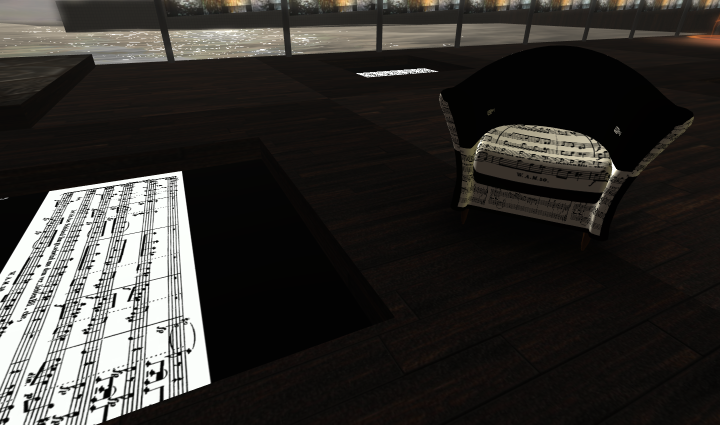
In contrast to the flatness and ominous quiet of "The Docks," "Aria" is highly tactile and sound-rich -- but in ways that connote an unsettling surfeit of pleasures. A few of the objects emit sounds (a vase even issues notes that drift in the wind); there is a music stream; there is a video stream with its own music, along with images of a score by "W.A.M.," i.e., Wolfgang Amadeus Mozart (again recalling Amadeus). The auditory elements pile up and collide into a cacophony of beauty.
Scattered about, many of them hanging in the air and often streaming blue lights, are numerous huge keys. Keys to what? Are they punning musical keys? But they have no sounds themselves. The women holding an infant aloft -- are they preparing to make an offering of their child, or like Achilles's mother, perhaps to dip it in the River Styx in order to give it invulnerability? These are only a few of the questions one asks to unlock the secrets of "Aria." There are innumerable narratives we might drape around it. None, perhaps, may explain it.
"The Docks" and "Aria" are exceptional installations. I don't know how long they'll be on view (I'm guessing a few months), but I recommend you go soon. You may want to go often.
Scottius is well known for his whimsical creations "mushROOM" and "Lunamaruna." "The Docks" (his installation at Originalia) has some of those elements, but its atmosphere contrasts dramatically: this is a spooky, possibly sinister place. A faint fog slightly clouds the imagery, colors are muted, there is little sound. Scotti's work always has a children's-book quality, which emerges here as a simplified realism laced with just enough exaggeration to tip it into fantasy ... plus a couple of monsters. The imagery is also startlingly flat. Even though it's a three-dimensional immersive environment, no matter where you look the picture looks like a drawing or a watercolor painting. The lack of shadowing and the use of mist contribute to this flattening. There is also an odd side effect. Although many builds don't make much use of sound, and "The Docks" does use sound to some extent (you can hear your footsteps as you cross the bridge into it, and there's a low ambient hum throughout), somehow this work feels immersed in an eerie silence. The monsters proudly standing on a dock seem to be surveying a location long abandoned and decayed -- and yet not so, for someone still lives in the house, from which light is streaming. Have the creatures just arrived? Has the occupant chosen simply to accept their presence and coexist with them?
 |  |
 |  |
 |  |
 |  |
(Click images to enlarge.)
As you can see, there are a few interactive elements in "The Docks": a rowboat with a lobster trap, an innertube (which you can rez from the dock), and not shown, an uneasy sleep in a bunk inside the house.
The disturbing tone continues in Eliza's "Aria." Her notecard describes it as "a whimsical nocturne engraved with all the aesthetic & charm of the River Styx," and the irony of that statement carries through in the installation itself, in which Eliza conjoins her meticulous, even luminous craftwork with an undefinable sense of menace and scenes that suggest unearthly sacrifice, all enveloped in an eroticism that is emboldened by its sacred anonymity and intensified by its leash. One thinks of Venetian carnival masks, in the way they arise in the films Amadeus and Eyes Wide Shut; indeed, many of the human figures in "Aria" wear masks, and there is something masklike about the gowns set around the scene. In one image, a woman's eyelids are pressed shut by death's head coins. Not for nothing does Eliza advise the visitor to use the gloomy Bristol windlight settings (if you use Phoenix, they should set in automatically).
 |  |  |
 |  |  |
 |  |  |
 |  |  |
(Click images to enlarge.)
In contrast to the flatness and ominous quiet of "The Docks," "Aria" is highly tactile and sound-rich -- but in ways that connote an unsettling surfeit of pleasures. A few of the objects emit sounds (a vase even issues notes that drift in the wind); there is a music stream; there is a video stream with its own music, along with images of a score by "W.A.M.," i.e., Wolfgang Amadeus Mozart (again recalling Amadeus). The auditory elements pile up and collide into a cacophony of beauty.
Scattered about, many of them hanging in the air and often streaming blue lights, are numerous huge keys. Keys to what? Are they punning musical keys? But they have no sounds themselves. The women holding an infant aloft -- are they preparing to make an offering of their child, or like Achilles's mother, perhaps to dip it in the River Styx in order to give it invulnerability? These are only a few of the questions one asks to unlock the secrets of "Aria." There are innumerable narratives we might drape around it. None, perhaps, may explain it.
"The Docks" and "Aria" are exceptional installations. I don't know how long they'll be on view (I'm guessing a few months), but I recommend you go soon. You may want to go often.
07 March 2011
Sabrinaa Nightfire: in peace, rest
Sabrinaa Nightfire, one of the mainstays of the Second Life art world, passed away last night of cancer, as reported by Bryn Oh, soror Nishi, Miso Susanowa, and most importantly, her aunt. Although I'd heard of her many times, I only met her once, last October when I was thinking about starting Split Screen. She was very encouraging, and I tucked her in the back of my mind for possible future artists there. But too late.
My heart goes out to her family and to those in SL who were close to her.
My heart goes out to her family and to those in SL who were close to her.
06 March 2011
"Digital Glove," Misprint Thursday's multi-award winner, at Split Screen
Misprint Thursday's "Digital Glove," I'm excited to say, will be exhibited on a sky platform at Split Screen while new immersive works are being created at ground level. This remarkable work exploits the capabilities of video in SL in unusual ways. Shortly after seeing it I asked Misprint if she'd be willing to install it at Split Screen this month. Then it won four awards at UWA's February contest.
"Digital Glove" will of course continue to be shown at UWA, and possibly elsewhere; but one benefit of being at Split Screen is that it won't be so easy to miss! At UWA, at first glance it appears as an absence -- some lines on the floor with a semicircle around them. You have to pay attention merely to approach, and then to notice the signs telling you to turn on video and walk into the semicircle. (Often people fail to see these things, sadly.) At Split Screen it should be much clearer that there's a work there, if for no other reason than people will go to Split Screen (hopefully) intending to see it.
I'm not sure whether I'll make interim exhibits a regular practice at Split Screen, so stay tuned.
"Digital Glove" will of course continue to be shown at UWA, and possibly elsewhere; but one benefit of being at Split Screen is that it won't be so easy to miss! At UWA, at first glance it appears as an absence -- some lines on the floor with a semicircle around them. You have to pay attention merely to approach, and then to notice the signs telling you to turn on video and walk into the semicircle. (Often people fail to see these things, sadly.) At Split Screen it should be much clearer that there's a work there, if for no other reason than people will go to Split Screen (hopefully) intending to see it.
 |  |
Subscribe to:
Posts (Atom)