 The story follows the explorations of The Inventor, who looks like Salvador Dali.** To teleport from each scene to the next, one must find the inventor's head (sometimes you must find the correct head). [Click photos to enlarge.]
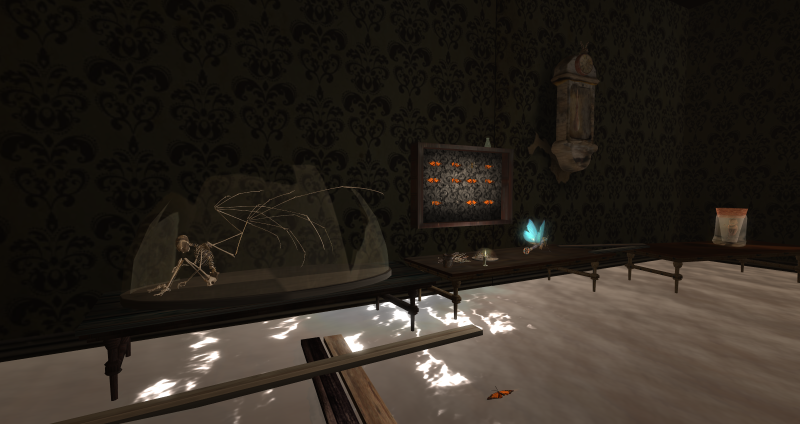
Just how The Inventor is an inventor isn't altogether clear: the first scene occurs in his lab (it looks more like a study), where it seems he's primarily engaged in collecting dead specimens, including a grotesque fetus in a jar (which might not be dead). Inventions there are, but they seem neglected or at best, things of his past. The lab is unkempt and in disrepair. There are broken display cases and other equipment. Water either dripping from a slow pipe leak or seeping in from outside has covered the floor with a couple inches of water. Everything speaks of inattention. The Inventor seems to have abandoned everything to its fate. A voice tells us the beginning of the story about an impoverished inventor with a lazy eye.
 |  |
Scene 1: Bryn Oh
A large hole opens up in one of the walls, with light streaming out. The Inventor climbs up to examine it. It is a portal. He enters. He finds himself in a large space full of holes, dominated by the huge face of The Overseer, who peers through three sets of pince-nez to examine The Inventor, now a specimen himself (albeit a live one). Everywhere there are windows at crazy angles, looking out upon other places, other scenes -- including one with The Inventor and The Overseer, but now at similar proportions, and one opening onto the very scene we're standing in.
 |  |
 |  |
Scene 2: Colin Fizgig
The Inventor leaps through one of the portals and finds himself in an austere old hotel (or perhaps office building?), with several long hallways extending outwards; they feel almost infinite, and infinitely closed, as every door (but one) is locked. The Overseer is talking with a repairman called The Doozer ("Fraggle Rock," anyone??) and tries to remind The Inventor of the key in his pocket. The Doozer wryly remarks, "He never remembers."
 |  |
Scene 3: Markus Inkpen
One of the doors is a portal leading to placeless white space where we follow the key the next scene, where a swarm of spheres surround you, swooping in with an electronic hum like science fiction alien beings. A voice urges you to click them into order to remove them, but more take their place. They contain images, which constantly transform. The voice also remarks on some of images that well up in the spheres.
 |  |
 |  |
Scene 4: Douglas Story & Desdemona Enfield
From there we land in a more placid but decidedly not safer realm, ruled over by enormous mechanical spiders with boxlike bodies and a strong dedication to optometry. Beware what you click on. In typically cheeky Maya Paris style, there are brain-warping surprises, such as a barrage of fried eggs. You'll need a wash after that. But think twice about getting one.
 |  |
Scene 5: Maya Paris
We were slyly warned of this place in the previous scene: the voice sometimes describes the images in the spheres, and observes of one, "A spider safe? Now that's a secure web site!" (That's one of the most dreadful puns I've heard in SL -- below even my own wretched standards. I'm pretty certain Doug is to blame. Or maybe he and Maya cooked it up together. Appalling. I'm so jealous. [EDIT: I have it from a knowledgeable source that the culprit was actually Desde. The source is Doug, so I have my doubts.])
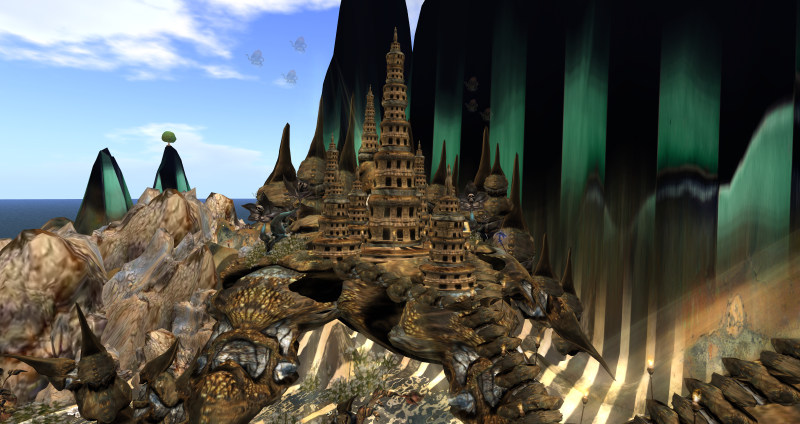
We next find ourselves in an astonishing landscape dominated by a small city of turrets and death's-head plants; in the bay reside giant fish. The city is simultaneously disturbing because of the death's-heads, and utterly wondrous. Like virtually all of Claudia's work, the city has an organic quality; it feels like it might be alive, indeed the death's-head flowers do as well. Flores, flores por los muertos.
 |  |
 |  |
Scene 6: Claudia222 Jewell
The next stop along the path is another lab ... but this time, it looms over us in gigantic proportions, with The Inventor's face peering onto the beaker and its experiment. The scene is far more dimly lit than most of Scotti's work, but there are still a couple of little jokes: the 64 megaliter beaker was made in the L.E.A., and there are bottles of "foraminifers" scattered about -- foraminifera being a type of plankton called "hole bearers," recalling the space of holes in Scene 2. (Thank you, Wikipedia.)
 |  |
Scene 7: Scottius Polke
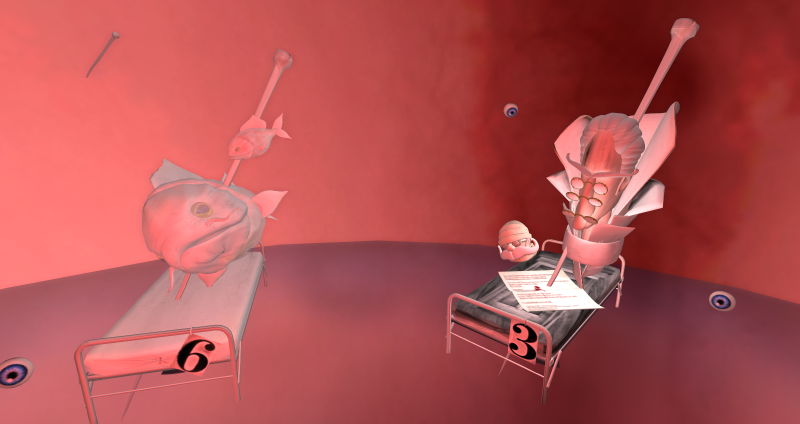
At last we reach the final scene, the most surreal of all. On a sky platform, hundreds of eyeballs reach up like a wave over a suspended, somewhat disassembled figure of The Inventor. Other eyeballs have arms and legs, and a couple of eyeballs follow you around. A Susa Bubble, mustachioed like a Dali, holds another figure of The Inventor like a dolly. In a sort of well, there are beds with numbers on them; one will take you back to the start. Figures from previous scenes, like The Overseer, The Doozer, spiders and some fish, are pinned to some beds a bit like specimens. On another is a suitcase, a pair of red shoes, and a note to remind us that "There's no place like home": is The Inventor, like Dorothy in The Wizard of Oz, in reality asleep? Underneath, holding up the platform is a huge eyeball, with skeleton legs (one ringed with a key) standing on yet another eyeball. The well is in fact inside this eye. Far below is yet another eye and bed, accompanied by a pig.
 |  |
 |  |
Scene 8: Rose Borchovski
Artistic collaborations don't always work. Every part needs to be pretty good, which even selecting good artists can't guarantee. Also sometimes the artists just work completely on their own, rather than build a collective whole. Frankly, I came to see The Path with doubts about the project.
But ... taken as a whole The Path is truly a success. First, each scene works very well on its own, and some are outright superb. The starting scene is filled with classic Bryn Oh imagery, but its core purpose is to provide a launching point for a story, and it does that well. I wasn't acquainted with Colin's work (at least to my knowledge), and his scene is wonderfully disorienting. The only previous piece I know by Marcus (for the Shanghai World Expo) didn't engage me, but this one is far more dynamic in the way it draws one's eyes down the corridors. Doug & Desde's swarm of spheres are nightmarish yet tinged with the secretive magic of the crystal ball. Maya maintains her trademark wit and penchant for practical jokes, this time mixed with a bit of the sinister. Claudia's scene is breathtaking -- literally. Scotti's colossal lab is scary but also makes you feel like a little kid on an adventure. And Rose's scene is deep in strangest dreamland. The only markedly weak element is the voiceover storyteller. It contributes to Colin's scene, but its presence is unnecessary and slightly patronizing in the opening scene, and annoying in Doug & Desde's (although I suppose necessary so that visitors know they should click the spheres); fortunately that's the last time we hear it. From then on, with no voiceover to force a interpretation, we are left to our imaginations, and The Path becomes the better for it.
The strongest element, however, is how the scenes link together. As hinted above, some scenes contain images foreshadowing later scenes. A few of Colin's windows open onto upcoming scenes (and even look recursively out upon his own scene). The images in Doug & Desde's crystal balls all foretell places to come. There are eyeballs and eyeglasses aplenty in various scenes. There's even an inconspicuous foretoken in Bryn's scene: a normal-sized version of Scotti's gargantuan beaker. Rose's scene in turn recalls the previous ones. These echoes and foreshadows create a vital coherence.
The Path bears comparison with Dekka Raymaker's excellent We Are Not In The World from about a year ago (as it happens, one of Bryn's Ten Best Builds in 2010), in which a inventor has vanished, leaving various clues behind that show he was looking for an entry into some other dimension; eventually you discover the portal where he departed into some fantastical world, but you can't follow him, wherever he is now. The Path instead provides no explanation for the portal, and the story for us is in where he travels after entering it.
For some reason lately William Carlos Williams's poem The Descent has been on my mind, particularly its opening lines:
          The descent beckons
                        as the ascent beckoned.
                                         Memory is a kind
          of accomplishment,
                        a sort of renewal
                                         even
          an initiation [...]
His better days behind him, Williams meditates on what memory now offers. The Inventor's better days seem to be behind him too. But as the images foreshadowing subsequent scenes show, The Path's temporal element is not memory, but futurity. As if to say: at the end, there may be new beginnings.
**Last year I revealed that Bryn's RL identity is Salvador Dali, or Dali 2.0, so I take this artistic decision as either a coy exercise in self-referentiality, or a thoroughly improbable demonstration that even the most minor critic may affect art. Or maybe Bryn's just messing with me. Or it has nothing to do with me. No, that's not possible ... is it?


