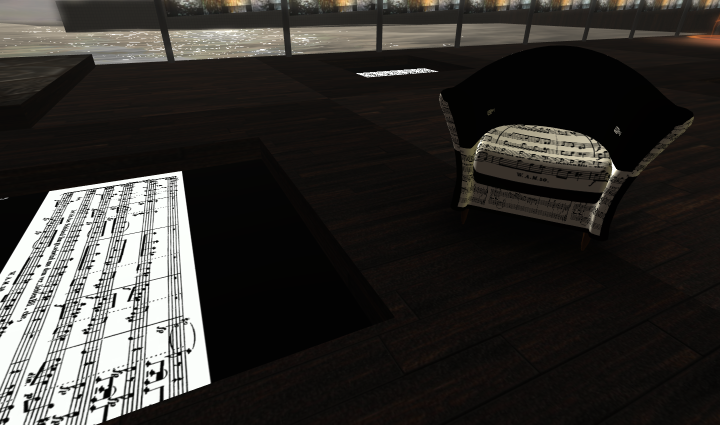
Eliza offers visitors two notecards about the installation, one fairly general, the other going into more detail (in case you don't receive them, I've copied the main parts below). salt has received a highly perceptive commentary by Inara Pey, and Strawberry Singh videorecorded a tour with Eliza, embedded below. I encourage you to read all those and, if you can carve out the time, watch the one-hour tour. There is more to learn about the work.
In this post I want to describe and to an extent interpret some of the details of the work -- and salt is dense with details. For length I won't even mention some of the smaller pieces, quotations from song lyrics, etc. One can only discover the installation's many aspects and items by spending time and if possible through repeat visits. Inara mentions spending over five hours; across maybe six visits, I've undoubtedly spent a similar amount of time with it. Realistically, most people won't visit so long. But salt is not fast food.
A degustation is a series of small dishes to be savored one at a time. That describes salt's overall structure: a series of rooms, each with its own setting. The idea is connected to the installation's title, since salt is the world's most common seasoning. But there is nothing small about salt. Even though it occupies only one level (nothing in the sky, nothing in the water), it feels huge, much larger than most sim-sized works. Seen from a distance, the installation seems to be hanging from chains, some of which are actually off-sim, which adds to the sense of vastness. Whatever the reason why the installation feels so large, when you come to the end ... you probably haven't. Look around, or wait a bit and a wall may open, or walk into it in case it's phantom.
Although each room has its own narrative focus, the installation follows an overall thematic thread: the breakage or damage we do each other, sometimes accidentally, sometimes intentionally, sometimes obliquely through malign attitudes. The theme appears topically as the subject of many rooms, and also visually through shards of pottery floating in the air. But the theme isn't treated simplistically: an important facet is kintsugi, the Japanese art of mending broken pottery with gold, which both emphasizes the breakage and makes beauty from that history.
In a sense, four objects announce the beginning of the installation. Most immediately is a dish such as one might receive at a Japanese meal, an hors d’œuvre of octopus (a sampling of our degustation). Second, to the side, a distorted and somehow malevolent red figure slowly turns, red particles streaming from his hands; but if you look at the distorted figure in profile, it has a more normal shape of a man. It is an image of a duality, someone who appears ordinary but is also dreadfully warped. This is emphasized by the pieces of red pottery slowly swirling at his feet, already partly mended; one of them has a picture of Eliza herself (the avatar, not the human). The third entrance piece is the bust of a woman in a pool of salt, fractured into a black part and a white part with a red line where they split, a thin blue stream coming from one eye, her lips sewn together in order to hold a spoon. This work suggests many things--the silencing of women, its effect on women of all colors, the taunt of having to hold a spoon in her lips but unable to receive (or for that matter, give) sustenance, and many more. The fourth entrance piece is easily missed: a poem title in a glass case on the right side of the wall at the building's entry. It is the Chilean poet Pablo Neruda's "Ode to Salt."
 |  |
 |  |
 |  |
(Click to enlarge)
Stepping into the building, we enter one of its major themes immediately. A girl, arms stretched behind her, stands in a broken teacup. She is Eliza's rendition of one of Degas's best-known sculptures, La Petite Danseuse de Quatorze Ans, of a 14-year-old dancer. The sculpture appalled some viewers, not because the girl was merely 14, but because she didn't look pretty. Eliza puts two reviewers' comments on the walls, comments that were not merely cruel, but bluntly misogynist, both of them reducing the girl to an animal. Next to the girl, the words of one describe her "bestial effrontry ... her little muzzle ... the beginning of rat" (the latter phrase twists the more-or-less affectionate nickname for a young dancer, petit rat -- little rat -- into a clear insult). Around the corner, we see that another critic depicted the girl's face as a "lecherous little snout," as if his own lechery was the girl's. There is also an except from a book on Degas telling of the artist's own misogyny. But on the opposite wall, there is a photo of the statue being gazed at by Marilyn Monroe.
The next room continues the dance images, but the narrative is now about Monroe and her own torments. Ballet dresses hang in a glass case; another glass case holds a top hat and cane (one wonders if there should be tap-dancing shoes). Ballet slippers hang from a barre. A photo shows Monroe at dance practice. There is a quotation from a letter she wrote to her psychiatrist during her stay in a psychiatric clinic in 1961, in which she recounted how she smashed a window with a chair in an effort to get the uncaring staff to notice her. And slowly floating through the space are pieces of glass showing different photos -- including one of a pill bottle: a year after the letter, Marilyn Monroe committed suicide.
Leaving the room, we come across a hallway where -- with a nod to Andy Warhol, but in a sharp riposte to his apolitical pop culture -- soup cans labeled "Vitriol: Sexual Rejection Soup" are lined up in display. The next scene we reach is on acid attacks upon women. Behind a screen displaying the molecular structure of sulfuric acid (H2SO4 -- sometimes called "oil of vitriol"), an acid rain drizzles over a woman's head, with a man's hand about to seize and maybe crush it.
 |  |
 |  |
(Click to enlarge)
Beyond the woman's head lies a suite of spaces, the first a rather surrealistic-seeming pair of chairs facing a ladder and a pseudo-eye chart. On each chair is a pillow -- one showing a blue eye, the other a brown eye. If you sit on the chairs you discover that the scene is a sort of dramatization of the famous "blue eyes–brown eyes" exercise by Jane Elliott in which children learned the experience of discrimination, using eye color as a surrogate for skin color. Behind this scene is a red-tinted version of Norman Rockwell's The Problem We All Live With, his portrayal of a young African-American girl on her way to an all-white elementary school. She faces a wall on which Eliza has placed a cross -- an ambivalent symbol recalling both the African-American churches which sustained the Civil Rights Movement, and the searing image used by the KKK in its terrorism.
To the left is another room. Here you are asked to play media. Eliza has a screen playing the Childish Gambino (Donald Glover) video "This Is America," which came out while Eliza was working on the installation, and the room itself broadly re-creates one of its scenes. The video also plays on the surface of the car and the cross (multiplying the latter's ambiguities). On the floor Eliza has written, "this is -not- just America." The video is a pungent counterpoint to relatively softer images about racism of Elliott's experiment and the Rockwell painting; one can see why a few people were uncomfortable with its inclusion. I think that on the contrary, it's a good choice, both because the video is a brilliant and incisive artwork arising from the Civil Rights Movement's successor, Black Lives Matter; and because it critiques racism in a way neither Elliott nor Rockwell could do: through an African American's own voice.
The next room welcomes you with a large fan, slowly rotating, with a face peering out from darkness. near it is a wall made of small cubes, some of which have been knocked out of place and some have fallen completely. The floor tells us that they represent transgender people who have been murdered. Nearby stands a angel, the first of several in the build. Behind the wall is a broken plate with a human heart printed on it, held by two hands. The right hand is tattooed with a clock face, as if to tell us, "Time will mend a broken heart."
 |  |
 |  |
(Click to enlarge)
Past the cubes we come to another dream-like scene: a giant red chair stands over a cradle. Two regular, white chairs are to the right, and a dresser is to the left, over which there's a picture frame. Large fish float about the space, perhaps like a mobile above a crib. The white chairs, the crib and the picture frame all have texts -- a poem. In her notecard and her tour with Strawberry, Eliza explains this scene alludes to a difficult time in her family's story, when her infant brother died. Knowing this, the giant red chair seems like a mausoleum.
Turning to the right, we see two of Eliza's gown sculptures. They are more or less echoes of each other. The white one has a face imprinted on it; the other is red and white, with a picture of Eliza at the head but somewhat displaced, and disturbingly, the words "Hurt Me" like a necklace. One wonders if this is an image of the internalization of misogyny, but it's not clear.
Then the tone changes. Continuing down the hall, there are photos on either side of Phan Thi Kim Phúc. One photo is famous: she is known as the "napalm girl," a Vietnamese girl of nine running naked, having been horribly burned by napalm during the Vietnam war. Eliza has placed the photo on a the pregnant belly of a kneeling woman (the sculpture rings a bell but I can't place it). Above her is a sculpture of four arms pouring red particles, an echo of the figure who stood at the intallation's opening area. However, on the wall facing this scene is Kim Phúc as an adult, now living in Canada, holding her baby. The pair of photos seems to say, "Life goes on. Things get better."
 |  |
 |  |
(Click to enlarge)
A similar contrast appears in the next room on. In a corner, an angel with its wings broken off and arms dragging to the floor sits dejectedly. In the center of the room there is a wheelchair with the word "unapologetic" tracked behind it, facing a picture that says "they're all Escher to me." The wheelchair has wings, and in front of it is a diagram showing where to move your feet for a dance. Like the two photos of Kim Phúc, we receive another image of overcoming obstacles.
The hall turns to the right and continues the more hopeful tone. About halfway down the hall, butterflies flutter about, their wings made of red pottery shards. A little further down, we find a blue and white pottery bowl, displayed in a glass case like you might find at a museum. The bowl is cracked, and gold has repaired the gap; a small piece of pottery floats inside the bowl. The case has a small label: "we are the fine art." We are forever being broken and being repaired. One can hardly avoid recalling the lines from Leonard Cohen's song "Anthem": "There is a crack in everything / That's how the light gets in." (You may click the case to receive a free copy of this sculpture.) As we approach the end of this hallway, pieces of blue and white potter slowly turn in the air, speared with what looks like large toothpicks, and they rise up, glancing past like the one serving octopus at the start of the build, and fly up into the air. And then, beyond the wall and into the sea, two large hands emerge from the water, holding one large shard -- made, perhaps, of translucent white salt.
 |  |
 |  |
 |  |
(Click to enlarge)
This, I would say, is salt's finale, but there are a few codas. Eliza has built a plaza, I believe intended mainly for large gatherings, but it can also be a place to sit quietly and digest the many small dishes she has served. At one end of the plaza, there is another angel whose wings have broken off, kneeling and apparently suffering or in tears. And to the side there are museum cases for three small angel sculptures, one looking in consternation at its broken-off wing, another of a parent hoisting its child into the air (perhaps to help it launch into flight?), and the last in a contemplative pose.
salt will be on view until the end of August.
SLURL: http://maps.secondlife.com/secondlife/LEA7/12/145/26
Strawberry Singh tours salt with Eliza Wierwight
Eliza's notecards:
Hello everyone,
Welcome to the notecard I've been avoiding like the second coming of the plague.
There are at least two fundamental options for viewing this work.
★ Cruise through at your own pace & savor salt at a visceral level.
★ The more daunting version: the above plus all the damn yet potentially interesting Eliza notes that follow.
As my primary presence Inworld is commercial, I've not engaged in the luxury of formal arts related work for quite some time, and certainly never on this scale.
I had formerly mused the idea that if I was ever to engage in art again, then this odd creature called 'salt' would evolve. Needless to say those originally indiscriminate ideas morphed into something entirely else during the course of actually creating it -- aided and abetted by a smaller project 'fourth position' I created on the fly for One Billion Rising earlier this year, which is woven into the foundation of sorts, though explored more expansively.
This work is predominantly instinctual, much shuffling ensued, and therefore not tidy in philosophy. Perhaps problematic is that I've been so enmeshed in the emotion of its creation that the premise of tying it up in a clever art historian-esque summary notecard-type endeavor was always going to remain rather elusive to me.
However this plays out, I had a moment of extreme personal catharsis during the creation of 'salt', and for that fact I remain grateful. Details in relation to this can be found in my comments regarding other cultural influences in the secondary, more expansive notes, if you're curious.
★ Artist's statement on salt - framework ★
As a fuller Immersive piece the philosophy of salt manifests in this way, I invite you to consider the journey through the installation as experiencing dining from a pre-set menu of somewhat unpalatable stories & truths. Some my own, some not, though all important to me irrespective of origin. I've quite deliberately misappropriating the term 'degustation'. This imparted itself as an ideal transition, as each segment-course is a unique work of its own volition. There are however other threads that drift through the work, as I've permitted myself a further interplay of symbolic references in relation to the accoutrements of sustenance. In the context of literal salt, a basic commodity that exists in most kitchens of the world, it became a metaphor for the things that wound us, a conduit?. ?Another? thread ?meandering? through this work relates to the Japanese philosophy of Kintsugi, embracing the unique, flawed or imperfect. Life ingratiates itself with such hardship at times.
If we are the wounded, then let us embrace where possible those challenges & scars, and in surviving them or in our empathy for others that do, see ourselves as the beauty?. We are the fine art.
Eliza Wierwight
=====================
salt
Eliza Wierwight
16 June 2018
Hello again oh brave one.
All the damn Eliza notes about this work. I have declined the opportunity to break down each course-segment of this work. You will find these additional notes loosely follow the flow of the work. I am not suggesting you stop and read as you experience salt. Let's just call this a window of sorts?
★ My late mother's talent for transforming the mundane to beauty; I owe my artistic mannerisms to her. A flower on a dining plate was not unusual in my childhood, during the good parts.
★ My late father relating stories to me of his one dining experience at Ferran Adrià's restaurant El Bulli in Spain, an experience I've always coveted, yet has to date eluded me. He professed to detest the experience & for a man of integrity I never once bought that declaration as the truth.
★ The eternally creepy Edgar Degas, such incredible talent, though my revelation falls more in favor of addressing his dark side. The misogynists & predators on the sidelines, lurking on the periphery of the time. To the 'petits rats' of the corps de ballet, these children were not of the haute bourgeoisie. These children who survived by providing sexual favors to the patrons of the Paris Opera. In fact to reclaim children everywhere that endure abuse I dedicate this course.
★ Marilyn Monroe, whom I've never been essentially drawn to, though over the years I've garnered an immense respect for the price she paid for exhibiting vulnerability, femininity & sexual exuberance. Her life.
★ Dear Andy Warhol, where to begin, a book I read at 19, the Moderns Exhibition I attended. His irreverence amuses me.
★ The late beloved David Bowie, that man, clearly an alien as I've always felt myself to be. His music has carried me through every stage of my life. I remain a dedicated Kook. "Will you stay in a lover's story? If you stay you won't be sorry, because we believe in you." https://www.youtube.com/watch?v=EsSlOGzPM90
★ William Blake, Maya Angelou and Pablo Neruda. Because words matter.
★ The musician Nick Cave, perhaps less said on this topic the better. What happens in Vegas stays in Vegas. Nick remains a haven for me and always will. I can state as fact that I was listening to 'Red Right Hand' at the time I created the Redman sculpture, a deity of the evil we all have the potential to do, spreading malevolence in his wake. https://www.youtube.com/watch?v=RrxePKps87k
★ The woman, children and men who have endured violence & maiming. My most profound respect.
★ Jane Elliott for her feminism, her fierceness, education and activism, her stance against racism, her support of LGBTQ community and taking the time to shoot a few emails to me regarding this work as I explained my commitment & a few screenshots. I remain both scared of and in total awe of this woman.
★ Childish Gambino, I appropriated his recent piece 'This is America' as a contemporary filler. The problem as I see it, is this is not just America. And, someone I have almost limitless respect for absolutely abhors this part of salt, though I've kept my failure rendered and I'm comfortable with that. https://www.youtube.com/watch?v=VYOjWnS4cMY
★ Norman Rockwell, an artist largely dismissed by serious art critics in his lifetime. And Ruby Bridges, one brave little girl.
★ The people who identified as transgender of an inner city neighbourhood I lived in during my early twenties. Glorious and generous, that created a sense of family around me, when I was disenfranchised from my own. The part of our communities that to this day that still endure vilification, violence and unlawful death merely for the fact that they are brave enough to be authentic. The families today with enough love, guts and credibility to extend unconditional love & support.
★ Again my parents, the segment with the fish and massive red chair relates to the cot death of my brother, the moment my family fell apart, the generational distortions that ensued, their pain, our pain. I'd created a version of this course, it was final and little memories kept returning to me as I surveyed it.. Then I started to pull it apart, and by the time I had imported the mattress texture of the prayer we said at bedtime as children, and it rendered on the mesh Inworld, I started to sob. Literally sob, and I scared myself in that moment, and more memories hit me like lost pieces of a puzzle that's infinite, and I wrote then and there the short poem presented in the area. I've always sensed digital worlds to have power, perhaps a magic of sorts, this confirmed it. I still struggle to view this segment of my own work, it breaks my heart a little for all involved.
★ Kim Phuc and this is not the first time I've highlighted her in work Inworld. She had a place of reverence in my Split Screen work 'Flowerdrum' that I created in 2011. When I was child I saw that iconic Nick Uc image of Kim after the napalm attack, and no adult would explain it to me. Why would a child be running down the road naked? What's happening to her skin? The beautiful photo of her with one of her sons nestled on her scarred shoulder is the answer I craved. Kim is doing well as it happens, living in Canada with her husband and activist in her own right and thankfully due to the advancements in technology has an ongoing improved physical status to the severe burns she endured at the tender age of nine.
★ The unknown artist who created the Vietnamese traditional tapestries I've highlighted in the Kim as Madonna segment. I wish I could name you.
★ My son, the light of my life when he laughs, he's represented in this work and knows it, he carries his own significant salt, and sometimes I carry it for him, and that's enough on this topic.
★ Maurits Cornelis Escher, thank you for messing with my head, simply thank you.
★ The lovers. Mine, yours, the World's, those of the past, present and future. This is the stuff of pure elation at times, we need this, love is an incredible gift.
Mechanics of the Work
★ The white textures seen throughout this work are literally salt, photographed in my kitchen, then edited to workable textures, it remains a primary texture throughout the installation.
★ The build itself, the housing, that's what I do when I get stuck, I listen to music and I play.
★ Mesh, I've really only just started wrangling mesh in the last four months, I thought I would hate the pursuit, I feared it. On the contrary I'm loving it, the freedom it's afforded me to express myself is a revelation. I have almost developed a fetish for hand-painting my designs.
★ Templates - they're about with enough reasonable investment of essence de Eliza for me not to feel twitchy about the fact. Fact, I don't have the time or inclination to reinvent the wheel, further more I've worked and pushed past my current skill levels numerous times with this work. Non, je ne regrette rien :P
Okay beautiful people, thank you for your time. I hope you've in some manner enjoyed 'salt'. If you have any questions-other don't hesitate to ask.
Kindest of regards
Eliza Wierwight.