Two bloggers (to my knowledge) have posted on Oberon's The Pillars so far: Kara Trapdoor and Ziki Questi.
And Tizzy Canucci created a machinima that captures the installation very well:
The Pillars from Tizzy Canucci on Vimeo.
Many thanks to all three!
Showing posts with label Oberon Onmura. Show all posts
Showing posts with label Oberon Onmura. Show all posts
25 August 2016
17 August 2016
Oberon Onmura's "The Pillars" at Split Screen
The Pillars: Four Moments of Contemplation by Oberon Onmura has opened at Split Screen. A striking work, it is composed of over 70 needle-like mountains jabbing into the air, mist or smoke rising from their peaks. Bird-like creatures fly overhead. It may seem as though that's all there is, but suddenly there are flashes of light, and towers as tall as the mountains appear scattered across the space, mostly straight up but some leaning, as quickly fading away -- like visual echoes of the mountains themselves. Out of four of the mountains, a platform juts forward, each bearing a bot -- standing about, kneeling, crawling, spinning. Oberon writes:


Oberon's work often has a minimalist quality with a mesmerizing effect, and Four Pillars is no exception. That sensibility contributes to the work's invitation to contemplate, or simply observe. He has used bots occasionally before; one doesn't ask who they are or what their purpose is -- they don't even seem to be symbols of anything in specific (although one can interpret them that way). They are more like icons of certain feelings, conditions or attitudes. Thus contemplation here is not necessarily about anything, although it can be; but absorbing the tonality of each location is essential.
The recommended windlights are "[TOR] SCIFI - Arrakissed 2" for the sky, and "[TOR] Arrakissed variation" for the water. If you use Firestorm they should kick in automatically. If you use another viewer, be sure to set them manually because they are crucial to the look and feel of this work, as you can see in the photos. Shadows and water reflections are also highly recommended -- use Ultra settings if you can.
This work is an installation which embodies terraforming, complex scripted objects, and bots. A "forest" of vertical mounds is inhabited by four avatars, each enclosed in a unique soundscape and constrained to a single animation. A plain white chair beside each avatar invites the viewer to sit and contemplate each small scene.


Oberon Onmura's The Pillars: Four Moments of Contemplation
(click to enlarge)
Oberon's work often has a minimalist quality with a mesmerizing effect, and Four Pillars is no exception. That sensibility contributes to the work's invitation to contemplate, or simply observe. He has used bots occasionally before; one doesn't ask who they are or what their purpose is -- they don't even seem to be symbols of anything in specific (although one can interpret them that way). They are more like icons of certain feelings, conditions or attitudes. Thus contemplation here is not necessarily about anything, although it can be; but absorbing the tonality of each location is essential.
The recommended windlights are "[TOR] SCIFI - Arrakissed 2" for the sky, and "[TOR] Arrakissed variation" for the water. If you use Firestorm they should kick in automatically. If you use another viewer, be sure to set them manually because they are crucial to the look and feel of this work, as you can see in the photos. Shadows and water reflections are also highly recommended -- use Ultra settings if you can.
The Pillars: Four Moments of Contemplation will be open through October.


31 December 2011
Selavy Oh's "Der Schauer" and Oberon Onmura's "Wave Fields"
I'm badly behind on blogging, which is a pity, since there have been some excellent builds recently. Unfortunately Haveit Neox's Second Libations is gone already; its destruction was quite a spectacle, I took lots of photos, and maybe I'll get around to posting them sometime.
But there are several builds currently on view that I've been telling friends about, and it's time I blogged them. I'll talk about two in this post, and try to get to some others later. I wish I could discuss them in more detail ... ah well.
Selavy Oh, Der Schauer at LEA24
In Der Schauer (The Shower, as in rain shower), Selavy brings together many of the strands she's been working on over recent years. She has also taken advantage of the new option of putting a windlight setting into an entire region so the sky is gray in all viewers, not just Phoenix and Firestorm (be sure you have the environment editor set to the default). In her blog post, she writes that "this installation has no static elements, everything is growing, falling, changing." By "everything," she means everything, and some things change in response to your own activities. Near the landing point there's a cloud of small cubes swirling around, leaving white trails behind them, occasionally bumping into each other, and sometimes changing color (you must have shadows on in order to see this, although you may find that it kills anti-alias). Larger cubes slowly shoot through the sky as well, leaving cubes behind them, bouncing on objects or the ground and taking off again. On some cubes, images flash on the surface. White towers like needles rise up from the ground, and occasionally collapse down again, making a clatter as pieces hit the ground; if you bump into or land on top of one of the towers, it will collapse immediately. Large sticks scattered about in piles will move if you bump into them. large circles of light form in the water and slowly disappear again. Step into the water, and land forms under your feet; land slowly changes on its own as well, so that if you return to the landing point it may have a different shape. Selavy also has two bots: Positive Hinterland stands motionless near the middle of the sim -- I've seen her get buried by the land -- while Negative Overland wanders aimlessly about the sim. (I'm not certain, but I think these bots are needed for terraforming operations, and when Negative bumps into things or walks onto the water, she'll alter the setting.) Along a circular perimeter there are occasional aurora borealis effects as well. Der Schauer is the ultimate expression of Heraclitus's dictum, "You can never step into the same river twice."
Oberon Onmura, Wave Fields at LEA20
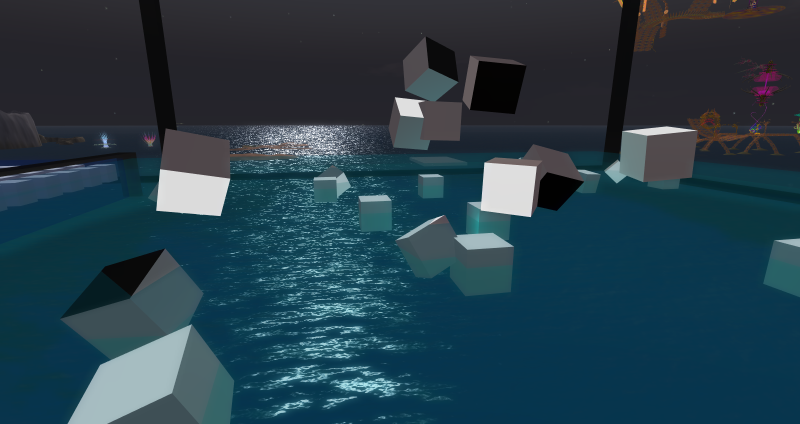
Oberon's build is all about motion too, but following his typical style, it takes a minimalist approach. He has split his sim into quadrants, each populated with a field of cubes floating above water, halfway into a large colored translucent screen. In each quadrant, one more or less random cube begins turning like a wheel. The ones next to it pick up this motion, and then the ones next to them, creating a diamond-shaped wave of movement across the quadrant, highlighted by the color sides that the cubes acquire when they start in motion (an interaction of the shaded cover over the quadrant, the black bottom side of the cube, and the angle of sunlight). Sometimes two cubes in different parts of the quadrant start turning one shortly after the other. Sometimes the wave stops at the quadrant's border; occasionally a wave passes through the border into the next quadrant; at other times; once in a while two waves interfere with each other. As the cubes turn, they stir up spray from the water, giving the waves' movement the sense of intense physical force. Once in a while, a field of cubes is switched off -- the cubes become translucent, shake out of their moorings, and in a thick mist of spray they sink to the bottom and disappear. The quadrant is repopulated with cubes in a different manner within each quadrant: methodically dropped from a dispenser in the air, emerging from below, randomly appearing and falling into place, or tumbling out from a jumbled flying mass.
Although both Oberon's Wave Fields and Selavy's Der Schauer pivot around the concept of change, the two installations also contrast. On the one hand, Der Schauer is primarily oriented around randomness and arbitrariness; Wave Fields, on the other hand, begins with the seed of a random cube launching into motion, and sometimes quadrants are refilled in an arbitrary way, but its focus ultimately falls on the powerful yet orderly expansion of waves until they crash into their borders. You need to meander about Der Schauer in order to discover its many elements; Wave Fields, however, calls for stillness and observation, even meditation -- in fact Oberon provides a tower where one can take a seat scripted with camera control, giving you a perfect view of the wave patterns. These are two of the many "must see" installations currently on view.
But there are several builds currently on view that I've been telling friends about, and it's time I blogged them. I'll talk about two in this post, and try to get to some others later. I wish I could discuss them in more detail ... ah well.
Selavy Oh, Der Schauer at LEA24
In Der Schauer (The Shower, as in rain shower), Selavy brings together many of the strands she's been working on over recent years. She has also taken advantage of the new option of putting a windlight setting into an entire region so the sky is gray in all viewers, not just Phoenix and Firestorm (be sure you have the environment editor set to the default). In her blog post, she writes that "this installation has no static elements, everything is growing, falling, changing." By "everything," she means everything, and some things change in response to your own activities. Near the landing point there's a cloud of small cubes swirling around, leaving white trails behind them, occasionally bumping into each other, and sometimes changing color (you must have shadows on in order to see this, although you may find that it kills anti-alias). Larger cubes slowly shoot through the sky as well, leaving cubes behind them, bouncing on objects or the ground and taking off again. On some cubes, images flash on the surface. White towers like needles rise up from the ground, and occasionally collapse down again, making a clatter as pieces hit the ground; if you bump into or land on top of one of the towers, it will collapse immediately. Large sticks scattered about in piles will move if you bump into them. large circles of light form in the water and slowly disappear again. Step into the water, and land forms under your feet; land slowly changes on its own as well, so that if you return to the landing point it may have a different shape. Selavy also has two bots: Positive Hinterland stands motionless near the middle of the sim -- I've seen her get buried by the land -- while Negative Overland wanders aimlessly about the sim. (I'm not certain, but I think these bots are needed for terraforming operations, and when Negative bumps into things or walks onto the water, she'll alter the setting.) Along a circular perimeter there are occasional aurora borealis effects as well. Der Schauer is the ultimate expression of Heraclitus's dictum, "You can never step into the same river twice."
 |
 |
 |
 |
 |
 |
(Click images to enlarge)
Oberon Onmura, Wave Fields at LEA20
Oberon's build is all about motion too, but following his typical style, it takes a minimalist approach. He has split his sim into quadrants, each populated with a field of cubes floating above water, halfway into a large colored translucent screen. In each quadrant, one more or less random cube begins turning like a wheel. The ones next to it pick up this motion, and then the ones next to them, creating a diamond-shaped wave of movement across the quadrant, highlighted by the color sides that the cubes acquire when they start in motion (an interaction of the shaded cover over the quadrant, the black bottom side of the cube, and the angle of sunlight). Sometimes two cubes in different parts of the quadrant start turning one shortly after the other. Sometimes the wave stops at the quadrant's border; occasionally a wave passes through the border into the next quadrant; at other times; once in a while two waves interfere with each other. As the cubes turn, they stir up spray from the water, giving the waves' movement the sense of intense physical force. Once in a while, a field of cubes is switched off -- the cubes become translucent, shake out of their moorings, and in a thick mist of spray they sink to the bottom and disappear. The quadrant is repopulated with cubes in a different manner within each quadrant: methodically dropped from a dispenser in the air, emerging from below, randomly appearing and falling into place, or tumbling out from a jumbled flying mass.
 |
 |
 |
 |
 |
 |
(Click images to enlarge)
Although both Oberon's Wave Fields and Selavy's Der Schauer pivot around the concept of change, the two installations also contrast. On the one hand, Der Schauer is primarily oriented around randomness and arbitrariness; Wave Fields, on the other hand, begins with the seed of a random cube launching into motion, and sometimes quadrants are refilled in an arbitrary way, but its focus ultimately falls on the powerful yet orderly expansion of waves until they crash into their borders. You need to meander about Der Schauer in order to discover its many elements; Wave Fields, however, calls for stillness and observation, even meditation -- in fact Oberon provides a tower where one can take a seat scripted with camera control, giving you a perfect view of the wave patterns. These are two of the many "must see" installations currently on view.
16 April 2011
Maya Paris and Oberon Onmura at Split Screen: Some Thoughts
The two current installations at Split Screen, Maya Paris's "Mind the Gap" and Oberon Onmura's "Second Pool," are connected in physical, interactive, and tonal ways. This is not to say that they are similar works, but that they create a balance, maybe even a sense of completeness.
Most of the physical links are visual or structural. The obvious one is that they both use large pools of water (Oberon's is square, Maya's circular), where much -- or in Oberon's case, most -- of the build is located. There is also a commonality in their use of underwater lights around their walls. The two installations actually have a bridge between them, and a shared landing point; previous builds at Split Screen were more discrete, with separate landing points and a TP for transit. They are quasi-physically connected as well: there is a "tunnel" using a TP between them.* And in a more directly interactive relationship, if you closely watch the wing of Maya's giant dandelion seed that somewhat overhangs Oberon's build, you'll see that when a shaft of light bursts from the water of "Second Pool," a pin in the wing turns briefly blue.
The pool of "Second Pool" is unmistakably urban: a square structure surrounded by park benches, with underwater lights around its perimeter and grilles on the pool floor emitting gasses. There's even a corner fenced off surrounding a dug out area into which some sort of outlet pipe. Strange fish or eels come out of that pipe. But ... what are they doing there? If you bump into one, they'll knock you out of the way, sometimes with quite a wallop: occasionally people have been knocked out of the sim entirely. No city park would permit such creatures. But they aren't aggressive. People have stood on the pool bottom for half an hour or more and never been touched. And where are the fish-eels going? They all swim toward the other side of the pool. Some die in the process; others burrow into the sand, to be seen no more. I don't think any actually reach their destination, whatever it is. One can ask similar questions about the balls and bolts of light that suddenly appear in the water, and the flattish white or light green blob creatures that skim about just under the surface of the water, and sometimes take off en masse into the air, going ... somewhere. The large, rectilinear, translucent "seaweed," which one might at first view as urban public art, begins to look increasingly alien. Has our city been colonized by species from afar, or are we on some other world entirely? But for all its burgeoning strangeness, this pool is at heart a calm, contemplative place.
Perhaps contemplation is not what some would seek in a work by Maya Paris. Whereas "Second Pool" departs from quotidian life, "Mind the Gap" takes pleasure in the most ordinary of things, that common but magnificent weed, the dandelion. Oh, and dunking people into water. And wearing amazing hats. While we're at it, also from floating in the air, though in RL that tends to be metaphoric. There's also a light touch of punning satire, as the words "Off [with their] heads" bursting from some dandelion globes allude to both blowing away dandelion seeds and -- scathingly -- the upcoming royal wedding in the UK. One does blow thick clouds of dandelion seeds everywhere by wearing the "crown" of a super-sized dandelion globe (sealing the satiric link between dandelions and royalty). There is also TP up to a small sky platform with a couple of spheres to sit on and be dropped to pool level, with a safe landing, until you walk away and ... mind the gap! Splash you go into the water. The build isn't "loopy," which is how I described Maya's "Veparella," but it's definitely fun. And yet ... when I'm there, I spend most of my time standing underwater, where there's another feeling. A friend experienced it even more fully: "When the chain took me down," she told me, "I had this feeling of complete relaxation. I don't know why, it just felt very ... relaxing. My mind just suddenly felt like everything else was far away and all that existed was this world that was enveloping me. I actually think it was after the splash that I first felt that. It was just a real out of body kinda experience. I felt so relaxed when I was done exploring, it just really agreed with me." Perhaps there's another connection between "Mind the Gap" and "Second Pool"?
I try to pair artists at Split Screen so that they contrast yet somehow fit together, but I don't ask them to collaborate or coordinate in any way, even though I've thought it might be interesting if they did. Maya and Oberon decided to on their own, after having already started building. I don't know how often that happens, but the results in this case are richly subtle, in a way that allows the visitor's own imagination to create part of the work.

*Truth in commentary: the tunnel idea arose during a conversation I had with Maya when the builds were almost finished, when I wistfully remarked that it would be fun if they could be connected by an underwater tunnel. She and Oberon ran with the idea, using a TP as the closest option.
25 March 2011
Playing Pool with Maya Paris and Oberon Onmura at Split Screen, now through 30 April
Opening today at the Split Screen Installation Space are two new works, "Mind the Gap" by Maya Paris, and "Second Pool" by Oberon Onmura. Most obviously, they both use large pools of water as part of the installation, but they also share other elements ... including a certain mischievousness!
Maya, of course, is renowned for the mischievousness and often outright loopiness of her builds. "Mind the Gap" in part recalls the joy of exuberantly blowing off dandelion heads, seeds scattering into the air, and punningly connects that to things one might do with royalty. Indeed, the centerpiece is the universe's largest dandelion seed. There is lots to interact with interact with here. Touch things, sit on things, get your crown. As Maya's notecard will tell you, the build has three levels, be sure to explore both above ground and underwater. And do mind the gap....

"Second Pool" is dedicated to the late Sabrinaa Nightfire, but that doesn't make it a somber piece, nor bar it from a little cheek. The build is park-like: a large square pool with restful benches surrounding it. At the corners are light blue rotating cubes: click one to get a ride into the pool. Here is where most of the build resides -- a strange ocean world with mammoth rectilinear seaweed, bolts and pools of sudden light, eel-like creatures swimming about, and at the surface, flat white spheroids that from time to time decide to float off into the sky. I mentioned mischievousness? Watch out for those eel-like critters....

There are many interconnections between the two installations, ranging from similarities to interactions to actual pathways (more than one!). They reward thorough exploration, so give yourself time to play!
Misprint Thursday's "Digital Glove" (a multiple award winner) will continue to be on display at the sky platform, accessible via the TP on the Split Screen kiosk.
The opening party will be Sunday, 27 March, at 2:00 PM SLT. The DJ will again be the exceptional and eclectic Isabelle Mavendorf. You may need to be persistent: at the last party, we filled the sim! Yes, it's a homestead so the limit is only 20 avatars, but I can tell you, it was a great party.
If you like what Split Screen is doing, please join the group!
Subscribe to:
Posts (Atom)