Showing posts with label Selavy Oh. Show all posts

31 December 2011

Selavy Oh's "Der Schauer" and Oberon Onmura's "Wave Fields"

I'm badly behind on blogging, which is a pity, since there have been some excellent builds recently. Unfortunately Haveit Neox's Second Libations is gone already; its destruction was quite a spectacle, I took lots of photos, and maybe I'll get around to posting them sometime.

But there are several builds currently on view that I've been telling friends about, and it's time I blogged them. I'll talk about two in this post, and try to get to some others later. I wish I could discuss them in more detail ... ah well.

Selavy Oh, Der Schauer at LEA24

In Der Schauer (The Shower, as in rain shower), Selavy brings together many of the strands she's been working on over recent years. She has also taken advantage of the new option of putting a windlight setting into an entire region so the sky is gray in all viewers, not just Phoenix and Firestorm (be sure you have the environment editor set to the default). In her blog post, she writes that "this installation has no static elements, everything is growing, falling, changing." By "everything," she means everything, and some things change in response to your own activities. Near the landing point there's a cloud of small cubes swirling around, leaving white trails behind them, occasionally bumping into each other, and sometimes changing color (you must have shadows on in order to see this, although you may find that it kills anti-alias). Larger cubes slowly shoot through the sky as well, leaving cubes behind them, bouncing on objects or the ground and taking off again. On some cubes, images flash on the surface. White towers like needles rise up from the ground, and occasionally collapse down again, making a clatter as pieces hit the ground; if you bump into or land on top of one of the towers, it will collapse immediately. Large sticks scattered about in piles will move if you bump into them. large circles of light form in the water and slowly disappear again. Step into the water, and land forms under your feet; land slowly changes on its own as well, so that if you return to the landing point it may have a different shape. Selavy also has two bots: Positive Hinterland stands motionless near the middle of the sim -- I've seen her get buried by the land -- while Negative Overland wanders aimlessly about the sim. (I'm not certain, but I think these bots are needed for terraforming operations, and when Negative bumps into things or walks onto the water, she'll alter the setting.) Along a circular perimeter there are occasional aurora borealis effects as well. Der Schauer is the ultimate expression of Heraclitus's dictum, "You can never step into the same river twice."

(Click images to enlarge)


Oberon Onmura, Wave Fields at LEA20

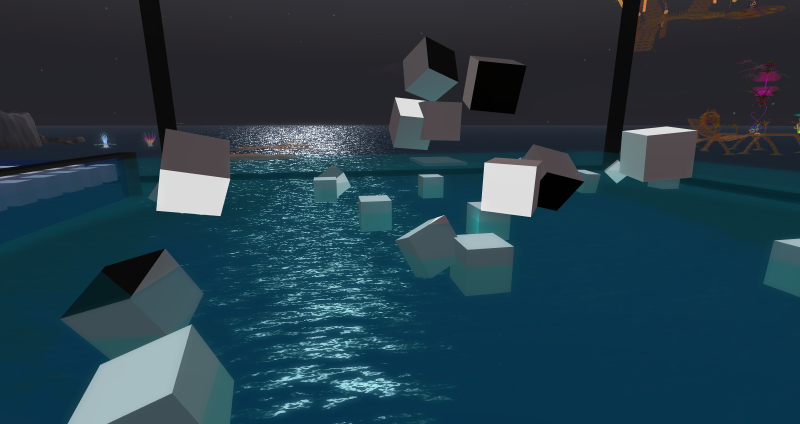
Oberon's build is all about motion too, but following his typical style, it takes a minimalist approach. He has split his sim into quadrants, each populated with a field of cubes floating above water, halfway into a large colored translucent screen. In each quadrant, one more or less random cube begins turning like a wheel. The ones next to it pick up this motion, and then the ones next to them, creating a diamond-shaped wave of movement across the quadrant, highlighted by the color sides that the cubes acquire when they start in motion (an interaction of the shaded cover over the quadrant, the black bottom side of the cube, and the angle of sunlight). Sometimes two cubes in different parts of the quadrant start turning one shortly after the other. Sometimes the wave stops at the quadrant's border; occasionally a wave passes through the border into the next quadrant; at other times; once in a while two waves interfere with each other. As the cubes turn, they stir up spray from the water, giving the waves' movement the sense of intense physical force. Once in a while, a field of cubes is switched off -- the cubes become translucent, shake out of their moorings, and in a thick mist of spray they sink to the bottom and disappear. The quadrant is repopulated with cubes in a different manner within each quadrant: methodically dropped from a dispenser in the air, emerging from below, randomly appearing and falling into place, or tumbling out from a jumbled flying mass.

(Click images to enlarge)

Although both Oberon's Wave Fields and Selavy's Der Schauer pivot around the concept of change, the two installations also contrast. On the one hand, Der Schauer is primarily oriented around randomness and arbitrariness; Wave Fields, on the other hand, begins with the seed of a random cube launching into motion, and sometimes quadrants are refilled in an arbitrary way, but its focus ultimately falls on the powerful yet orderly expansion of waves until they crash into their borders. You need to meander about Der Schauer in order to discover its many elements; Wave Fields, however, calls for stillness and observation, even meditation -- in fact Oberon provides a tower where one can take a seat scripted with camera control, giving you a perfect view of the wave patterns. These are two of the many "must see" installations currently on view.

31 July 2011

Selavy Oh and Kolor Fall at Split Screen

Starting today (31 July) and continuing until the end of August, Split Screen is hosting Random Walk by Selavy Oh, and Inverted Paths by Kolor Fall (Patrick Faith).

In her blog, Selavy describes Random Walk as "a continuously changing algorithmic installation belonging to a series of permutative spatiotemporal works." It is constantly transforming: occasionally I've gone to look at though it had disappeared because it had moved rather high up, and other times one practically lands inside it. You can affect the evolution of the installation by flying through it. "Sitting" on one of the elements takes your camera around the build.

I should mention, it's best to see Selavy's piece using SL's own Viewer 2.7 (and above). V2.7 has a new feature for lighting and shadows that really brings out the color in Random Walk; Phoenix, Firestorm and other TVPs don't have it yet. (This is probably the only time I've ever recommended anything V2.) Unfortunately, the lighting and shadows feature also kills antialiasing, so be prepared for jagged edges.  The colors do show in the other viewers, just not as well. I recommend playing with different windlights and day settings. (Click photos to enlarge.)

Random Walk (dawn)

Random Walk (night, using Viewer 2.7)
Inverted Paths, Kolor told me in conversation, "is about space/time differentials and path theory." His recent work "uses one geometry for positive time ... flips that geometry for negative time ... and the 'movement/life' is the tension between paths [...] between the two space/time spaces." This work too continuously changes and interacts with the visitor's very presence. As you walk through it, paths form behind you. You can "sit" on one of the cubes rolling in the air, and as you dance, curling paths form beneath you. The construction also interacts with itself, as pyramids sometimes flip in relation to the paths. As Kolor's comments hint, mathematics underlie Inverted Paths  -- it's fun, but more than that too.

Inverted Paths (noon)

Inverted Paths (sunset)
In a striking case of artistic serendipity, there are several commonalities between Random Walk and Inverted Paths -- as should be obvious from their related titles. But that similarity arose through the artists' similar ideas, not through conversation (as best as I know): Kolor built most of his installation on his own sim, placed it at Split Screen just a few days before opening, and only gave me a title a couple days later, having no idea what Selavy called her work. More than that, as you can see from my quotations from each artist, both works have a mathematical basis focused on the space-time relationship.

The serendipity doesn't stop there: Miso's Time as a Helix of Semi-Precious Stones continues on display at the sky platform. Although focused on her experiences of time and space while on a meditative stroll rather than math, at play in her piece are similar issues of time, space, and the path one creates by following it.

Get to all three installations from the starting point here.

14 May 2011

CONSTRUCT by Selavy Oh

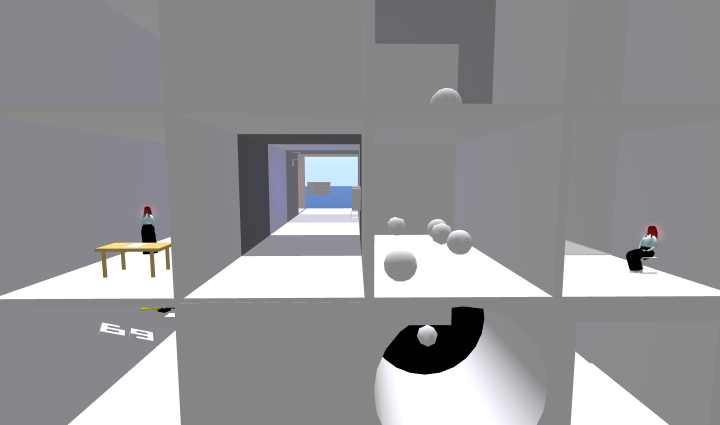
Selavy Oh has a reputation for artwork that makes unusual use of Second Life capabilities.  In CONSTRUCT, she has created what she describes as a performance, in which she built a cubicle every day for 75 days, forming a three-storied construction, a square of 25 cubes laid out at each one.  (She describes the process in her blog.)

Some of cubicles are static, with perhaps an image on the wall. In some cubes, things happen. Balls may drop to the floor and spill out of the building. Numerous blocks with the number "69" (for the 69th day?) fall up to the ceiling. You might fall through the floor. You might turn parts of the building invisible. You might find yourself ejected. There are two Selavy Oh bots, one named SelavyOh, the other OhSelavy; sit across from one of them, and you'll find yourself in a sync'ed animation in which one of you stands while the other sits, back and forth. One of the rooms has a chair that will give you a camera tour.

Not only do things happen in some of the rooms, but in a sense, the rooms themselves happen. They move. Stay in one place for a while, and eventually cubes change position as you stand. Return for a second visit, and the rooms will be in a completely different arrangement. Even their content seems to alter: you may find new rooms, while others will be nowhere to be found.

There is another level within CONSTRUCT. Some of the rooms present a question, all on the same model. "And what, for example, am I now remembering?" "And what, for example, am I now thinking?" "And what, for example, am I now seeing?" The last, undoubtedly the seed of the others, comes from Wittgenstein's Remarks on Colour:

What actually is the 'world of consciousness'?—That which is in my consciousness: what I am now seeing, hearing, feeling....—And what, for example, am I now seeing? The answer to that cannot be: "Well, all that" accompanied by a sweeping gesture.

Finally, CONSTRUCT presents various forms of self-representation. One cube contains a schematic model of CONSTRUCT itself, which (at least some of the times I went) showed your current position within the build. At other locations, you see the scripts operating the installation. The Selavy Oh bots are another form of self-reference, the constructor placing constructions of herself in her construction. One room contains a box listing artworks antecedent to CONSTRUCT, such as pieces by Sol LeWitt, Vladimir Tatlin, Bruce Nauman, and of course Marcel Duchamp (who named his alter ego Rrose Selavy). You can also pick up a mini-CONSTRUCT to take home with you, with the nine letters of CONSTRUCT switching about the face of a 3x3 box.

One might describe CONSTRUCT as a thinking machine, a machine that thinks, which one can watch as it ponders images, observes its own perceptions, making and unmaking connections unceasingly. To call it a "machine" is not a criticism. On the contrary, there is an significant history of art-machines, not least among them those created by Marcel Duchamp: "Bachelor Machines," optical illusion machines and many others.

CONSTRUCT is a highly self-aware installation, cognizant of its own transience and ongoing transformations, laying bare its own workings, self-aware without being self-conscious.  It is, one might say, a machine for making art -- that is making art -- with LSL scripts as its instruction manual and self-referential imagery as its illustrations.


Click on images to enlarge. [Post reconstructed from a draft after The Great Blogger Crash.]