02 August 2012

Giovanna Cerise, and Jo Ellsmere & Pyewacket Kazyanenko at Split Screen in August

During August, Split Screen presents Giovanna Cerise's Synesthesia (opening 1 Aug) and a performance piece by Jo Ellsmere & Pyewacket Kazyanenko titled Pardon Our Zeitgeist (opening 5 Aug).

Synesthesia is when one sort of sensation is perceived as another. Most often a sound is also experienced as a color (or vice versa). Composer Alexander Scriabin and painter Wassily Kandinsky both explored synesthesia, and Giovanna's work builds (literally) on their ideas. Quan Lavender has written an excellent blog post about Giovanna installation, which I can't improve upon, so go read it. Synesthesia uses a special windlight setting, which should turn on automatically if you use Firestorm or Phoenix.  Otherwise, switch to "Sheer Surreality."  Be sure to have sounds all the way up.

Synesthesia (click photos to enlarge)

Pardon Our Zeitgeist, by Jo Ellsmere and Pyewacket Kazyanenko, is a performance piece. They call it a "Second Life painting in 4 dimensions," about online communication and relationships. It's a bit hard to describe right now because it isn't ready yet -- it'll open on the 5th. Turn on media as well as local sounds.

Pardon Our Zeitgeist (click photo to enlarge)

18 July 2012

"Virginia Alone" by Bryn Oh

It's curious that with all the reviews of work at the LEA sims and various other builds around the grid, there don't seem to be any commentaries on Bryn Oh's new installation at Immersiva, Virginia Alone, which was part of the Santa Fe New Media Festival -- or if there have been, they've passed me by.  Maybe people feel she's popular enough not to need advertisement, or they assume her popularity is somehow a reason to ignore her, or they haven't bothered to check out her work thinking it's more of the same, or they're afraid to comment critically on such a major figure, or who knows what the reasons are. Anyway I think she should be treated like any other artist in SL, and given that I'm quite willing to yell at her ("Bryn, get your gray ass over to Split Screen!"), I don't mind taking a stab at Virginia Alone, just to offer a starting point.

The problem is, my thoughts about it refuse to gel. And I'm willing to consider the possibility that they won't gel because the Virginia Alone exists in a state of indeterminacy. As most readers probably already know, it's about an elderly woman (over 80 years old), blinded by cataracts, who lived by herself in a remote farm house in the Canadian countryside, and later was moved to a nursing home. (See Bryn's full account of Virginia's background.) According to Bryn she suffers from schizophrenia, but I don't know if that's an actual diagnosis or Bryn's own best guess; be that as it may, it's clear that Virginia has delusions that she herself sometimes recognizes as departures from reality.

Over the years Virginia recorded hundreds of cassette tapes about her activities, thoughts and experiences. From the cassettes Bryn culled over an hour's worth of material, coupled it with machinima and real-world video recordings, and turned it into nine YouTubes which one accesses by clicking on cassette players scattered (sometimes hidden) around Bryn's simulacrum of Virginia's house. Thus the cassettes -- indirectly, Virginia herself -- form the basis of Virginia Alone.

What this means, and one of the things that I think makes the work strangely indeterminate, is that Virginia Alone is a Second Life installation dominated by the material Bryn has placed outside SL. The work constantly takes us out of itself, or rather, into a different-world part of itself. One of the YouTubes even blurs the difference: one scene focuses on a handwritten letter, and then cams backward and down the hall, at which point you realize that the letter is actually an image imported into SL and the entire scene is machinima. At the risk of sounding too cute, it seems that Virginia Alone, like Virginia herself, exists in multiple realities, both equally real and unreal. This interpretation is underscored by the cassette tapes made at the nursing home, in which the background sounds -- people talking or yelling or screaming, and various other noises -- are at least as compelling as Virginia's voice calmly talking in its midst (in fact for me, sometimes more compelling), giving the real-world recording a sense of unreality.

Click on photos to enlarge

One obvious difference between Virginia Alone and Bryn's well-known older installations, such as the Rabbicorn trilogy, is that she has more or less departed from the arena of robot girls and robot animals. As she has done in many of her recent builds, the main lines her approach is more or less naturalistic: an isolated island with trees, rocks, a water-logged boat, a house modeled after Virginia's actual house, cobwebs and so forth. It's more like her oil paintings, which Bryn occasionally imports into SL, and you'll find one in Virginia Alone. Admittedly I'm usually not enthusiastic about art in SL that attempts to reproduce RL, but Bryn makes it work by her inclusions of the strange or uncanny, and anyway, Bryn has the right and need to take new approaches. (One thing that has not changed is her obsession with insects, of which there are quite a few in the YouTubes.)

And I did say, "more or less." The basement plumbing is a chaotic network of pipes that seems characteristically Bryn, and not a bad way to image Virginia's thought patterns. More to the point, she has placed a number of her signature motifs (such as poems, piles of shopping carts, and a robot rabbit) in the house and on the island, and she has a bit of cam build as well, so be sure to look around closely.

Click photos to enlarge

You may notice that I haven't addressed the emotional impact of Virginia's tapes. Basically I think that would be redundant, visitors will naturally focus on it themselves. The question I wanted to ask (or ask myself) is how Virginia Alone works, what aspects contribute to its impacts and meanings.

Unless you're blessed with lots of free time, you'll have to visit Virginia Alone several times in order to watch all of YouTubes and explore the house and the island. When I was in the upstairs I happened to visit the rooms left to right, which turned out to have a very good effect.

SLURL to Virginia Alone: secondlife://Immersiva/16/157/21

19 June 2012

She's baaaaaack!

My friend Kara, who left SL about a month ago, has decided to come back! She talks about it in her blog. She's been a great supporter of the arts in SL, and a great source of news about activities if you want to go to something fun. Plus she's a wonderful friend and great to joke around with. Welcome back, Kara! Yay!*

*In case you're wondering why I'm not teasing her mercilessly, I am -- but that's more fun to do privately, where I can make better jokes! :-D

07 June 2012

Rose Borchovski: The Inevitability of Fate

• I like words. Sometimes I know not to use them. I'm going to keep this simple.

• The photos below are small because I want you to click on them to see them larger. They are no substitute for going there.


• Use the recommended windlight settings.

• Turn local sounds all the way up. Turn your master volume up.

• Click on everything you can find to click on.

• Cam everywhere, including from above, around corners, and close up.

• Give yourself at least 45 minutes.

• Yes. It's that good.

• GO.

02 June 2012

Betty Tureaud and Trill Zapatero at Split Screen

During June, Split Screen is hosting Betty Tureaud's Liquid Crystals and Trill Zapatero's The Apocalypse Will Not Be Televised.  They are thoroughly immersive installations of completely different kinds.

In Liquid Crystals, Betty expresses her fascination with crystals and their use in technology. It has three levels. The landing point is breathtaking and magnificent: a vast field of color that spreads to the horizon. On a black platform are two small spheres. Sitting on them brings you down into a large cylinder where you float within Betty's bright colors. Standing up from there, you tumble down to the base of the cylinder, where you walk amid cubical and conical crystals, some in a pile in the middle.

Betty Tureaud, Liquid Crystals

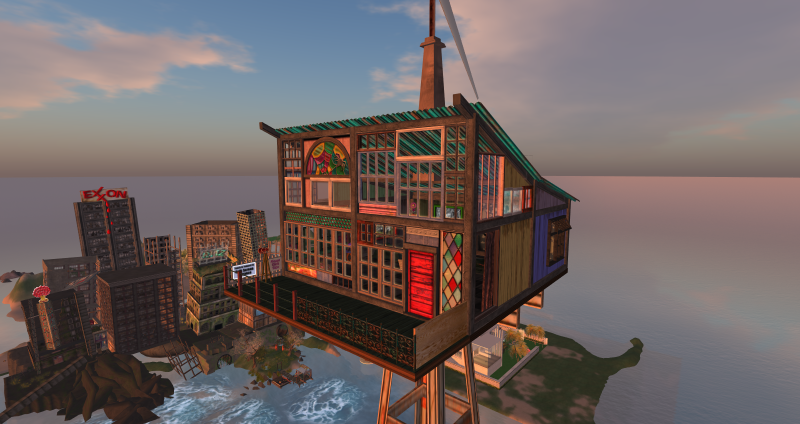
In contrast to Betty's highly abstract piece, Trill's Apocalypse is concrete and narrative. There's been a run of apocalyptic work lately (including, at Split Screen alone, shellina Winkler's Apocalypse 2012 and Alizarin Goldflake's Acquarella: After the Apocalypse). Trill's installation is unusual for its optimism. We see the destruction, but also reconstruction. The installation is designed to lead us along a path through ruins occupied by ghosts and rats, and still crumbling around us. However, many of the walls have graffiti (among them, images by Hieronymus Bosch), a few with clues to the background to the disaster. Eventually the path takes us to a paddleboat, the beginning of the salvaging of materials. The boat brings us to an oil rig that has been wholly re-purposed, and now boasts a garden, chairs and lamps made from various types of detritus, and a small house powered by a wind turbine.

Trill Zapatero, The Apocalypse Will Not Be Televised

Showing June only, so go see them!

23 May 2012

Bye Kara ....

My wonderful friend Kara Trapdoor has left Second Life. Those of you who knew her know how active she was -- she seemed to be friends with everyone, know about every event, and made blog posts and photos and machinima of everything. She was fun and a little bit hyperactive and a sweetheart. She was also one of the people who kidnapped me for The Great Makeover.


Take care of yourself, Kara. We'll miss you. Hope you come back some day. In the meantime, hugs!

13 May 2012

To LEA or Not to LEA


This post is a belated response to Quan Lavendar's discussion of some controversies regarding the LEA sims. At the time I was too busy to comment, but after Quan and I discussed some of the issues during the opening reception for A Rusted Development at LEA1 (a great installation, by the way, albeit a bit disjointed), I decided to write this post, expanding on some of my original thoughts. And from the start, I'll state that a number of my comments are based on ignorance ... which will be part of my point.

Many people have strong feelings about the LEA sims, sometimes accusing the committee's members of bias or favoritism or corruption or cliquishness. I'd like to pose a contrast that raises some questions. How do the independent curators compare? I don't know how the people who run (for example) Art Screamer, MetaLES, Originalia, and NMC select artists, but at Split Screen only one person has any say: me. I invite whoever I want to invite. Once in a while someone asks to build there; sometimes I say no, and sometimes (actually more often) I say yes. In theory, people could easily charge me with favoritism or whatever else, yet I've never heard that complaint raised against me or any of the other independent curators (not yet, anyway ... I've probably just invited it). So one has to ask, what's the difference between the necessary selectivity exercised by independent curators, and the necessary selectivity exercised by the LEA committee? Imagine the LEA committee didn't manage the sims on behalf of Linden Labs, but instead paid for the sims themselves. Would people's attitudes be different? I suspect they would.

Most likely, the LEA sims raise so much debate because of their "official" character. I know artists who won't even apply for a LEA sim because of their "official" status or their feelings about the LEA committee. Conversely, I'm told that one or two LEA members have been unwelcoming toward some artists, even accusing a few of "hating SL." The situation is a pity, because I bet those artists could do amazing things with a full sim. However, their refusal to apply helps make the point: the sims' "official" character raises hackles. If I'm right about that, then one of the questions artists need to ask themselves is why they have such strong feelings about the LEA sims. Does the intensity derive from the desirability of a full sim? Does "official sponsorship" offer higher status, cachet or clout? Is there a sense of entitlement or a right to LEA land? Will a LEA sim -- and only a LEA sim -- enable you to create better art? What's the difference between a LEA sim and an independent sim?

I don't envy the members of LEA; they have a tough job. That doesn't mean I agree with everything LEA has done. In fact I don't even understand some of their decisions (why 5 months, rather than 3, 4, or 6?). They do a crappy job publicizing work (like most artists). They need to be cautious about what they say to whom, and they sometimes fail. And they face the problem that confronts every sponsor of a new work: you make a bet, and there's a chance you bet wrong. Most of the work LEA has sponsored has been good, some has been amazing, but there have been some duds too. The possibility of disappointment is simply part of commissioning new work.

It is true that Linden Labs benefits from LEA's work -- the company didn't provide the sims (tenuous as they are) out of pure generosity. So? If LEA's work simultaneously helps artists and helps Second Life survive, I don't see the point of faulting them for it. (Some of LL's calls for promotional work are more exploitative.)

However, LEA suffers from a lack of transparency, starting with the committee's composition. I for one have no clue how its members were selected. A couple of them I've never even heard of, let alone observed their interest in SL art. (For what it's worth, none of the members are on my Friends list -- not even Bryn, who had an installation at Split Screen.) The grapevine says that there are major conflicts among personalities and/or priorities, which makes me wonder if the committee's membership needs to be reconsidered. It also suggests that the committee doesn't have a coherent set of goals for the sims. Do they feel it's important to include artists who haven't built on a full sim before? Do they strive to have a mix of (say) highly scripted and unscripted work? Do they place a priority on work with a narrative element? I have no idea -- but if they do have an articulate set of goals for the sims, it would help to set them out publicly. If they don't have clear aims, then the committee really isn't a committee: it's a squabbling reality TV show, and from the outside its decisions can easily look arbitrary or political -- even if they're nothing of the sort.

Which brings me to my major concerns about LEA: whatever the committee thinks or intends, from what I've observed it has given itself the appearance (and maybe reality) of operating in a top-down manner, and fostered competitiveness and jealousy among artists. Competitiveness and jealousy in turn are likely to make the sims more trouble than they're worth to Linden Labs. LEA needs to work toward generating a sense of community. But artists must bear some responsibility for achieving that too -- LEA can't do it alone. (I have other concerns, but these are at the top.)

The heart of community is transparency. I propose a set of forums, in which the LEA committee members explain what they do, hear and respond to concerns (maybe only to issues submitted in writing, in order to avoid heckling and recriminations), and seek ways to resolve shortcomings. I would also like artists to discuss why they respond to LEA the way they do (honesty would be nice, though I'm not sanguine about that). It might be best if LEA didn't directly sponsor the forums: instead, FreeWee Ling's ArtGyro group might provide more neutral auspices, although the forums might be held on a LEA sim (e.g., the theater space). (I haven't talked with Free about this; she's a smart woman, so she'll probably run like hell.)

I'd also encourage LEA to use its blog to explain as much as they can about themselves, their aims, their hurdles, and especially their relationship with Linden Labs ... or from what I hear, lack of relationship, and being upfront about their problems getting responses from LL might nip a lot of problems in the bud.

Meanwhile, to any artist angry about not getting a LEA sim: that's life. LEA is not all there is to SL art, and getting a LEA sim isn't the only chance -- or necessarily the best chance -- to do great work. There are other sims in the virtual sea. So I might not feel sorry for you. I might be celebrating, because now I have a shot at getting you. Maybe you should be looking for people like me. In fact maybe you should flip your perspective -- independent curators have to be far more selective than LEA because we have less land to offer, so maybe we're the plum gigs. Support your local independent curators.