12 July 2011

In which I cave in and create a Facebook page ... and learn that I can't be your friend

Some people hassled me about not having a Facebook page. They told me it'll help promote Split Screen. Well, OK, that's pretty persuasive. Then I discovered some evil creature snagged the name "Dividni" on YouTube before me, so I decided I better get my name in FB before someone else does. So if you use FB, be nice and pretend you're a friend of mine or I'll feel very very foolish. And beware of pseudo-Dividnis!

I think this link works. Apparently, if I get enough fans there's a prize: I get to have a page without a whole bunch of squirrelly numbers. Unless I want squirrelly numbers I guess.

http://www.facebook.com/pages/Dividni-Shostakovich/243285845684004

Now, most people sign up with FB with regular personal accounts, but as probably everyone has heard, FB occasionally trawls through and wipes out SL accounts. Poof. No warning, nothing. But they don't do that with a "page" account, which is what non-people like politicians and corporations use (shut up, Supreme Court!), and one option is to be a fictional character. After all, if you've declared to the public that you're a fiction, they can't exactly ban you for lying. So that's what I chose. (As did Botgirl Questi and various others More Famous Than Me). Hopefully this will make me a less tempting target for Viagra ads, poking, and all the other Facebook-y treats that my RL page gets (which, by the way, I check about once every two months).

The down side turns out to be that I can't "friend" with anyone and they can't "friend" me.  All they can do is "like" me. Which is OK, except for the fact that it sucks. In fact, FB removes the search bar from my page! It's lonely being a fiction.

I could've made a page for Split Screen instead, but that seemed like a poor idea since that's not the only thing I do or think about in SL (well, friends of mine may beg to differ!).

I do get notifications about who Likes me. I got a friend to like me, and then discovered that checking who likes me opens up a list of other people who might like me. The weird and worrying thing is that among the couple dozen people in SL I'd never heard of were a couple of my actual SL friends. FB figured that one out instantly. Chills up my spine.

It's starting to look like Google+ may actually be worse for SL, since apparently Google wants to limit profiles to "real people." So far it doesn't sound like they'll even offer an option for being explicitly fictional. Which raises a serious problem: if Google wipes out avatar identity profiles, and those identities maintain blogs, the blogs will be wiped out too. Including this one.

Miso Susanowa has written an excellent blog post on Google's position and its irrationality. She raises a number of points, including marketing ones, but at the very end she mentions another that deeply concerns me. She writes:
This is the Information Revolution: we move outside the established channels because they no longer serve us; we seek our own communities and establish our presence and our reputations by our words and actions; we speak amongst ourselves and we use the tools of a free press to do it, uncontrollable by gatekeepers and sluice-gate operators who seek to stem the flow of community under the guise of commerce. This is the true meaning of "information just wants to be free"; not free as in 'free beer' but free as in 'free to move between people.'
So here's the question: is there a right to use pseudonym? If so, would Google violate that right by wiping out accounts? Is being an avatar a freedom of speech issue? I think so. I think everyone in SL ought to think so too.

11 July 2011

Rod Humble interviewed by "The Mark" -- with intriguing results

"The Mark" published an interview with Rod Humble, Linden Lab's CEO. (Thanks to Kara Trapdoor for blogging this.)  It's an interesting read, especially as it raises questions about some of Linden Lab's strategies, which seem at odds with Humble's remarks. In fact he sounds like he shares more views with SL's creative community than with Linden Labs, or at least the Linden Labs of today.
Humble: Second Life is a completely user-created virtual world. It's really, at its bare bones, a creativity tool.
LL's slogan of "Your World. Your Imagination" was killed off some time ago, but Humble seems to be raising its ghost. One can only hope that he succeeds!
Humble: At Second Life, we’re really just following our customers – our creators – and seeing where they take us next.
Umm ... we wish. Get this on LL's mission statement, please!
Humble (responding to a question about "true selves"): I don’t have a clear answer on that, but I do have an opinion. There have been a series of high-profile people, from the head of Facebook to the Pope, talking about how social media should be about centering the individual – that it is all about your real life and ensuring that you don’t become a fractured person. I respectfully disagree with that.
I think that one of the healthiest things that technology can do is actually help us develop the different dimensions of ourselves that we portray in different situations. For example, the "me" at church is very different from the "me" who plays an online shooter game. The "me" talking to you now is very different from the one who will be at my parent-teacher-association meeting later tonight. We’ve always had that. I actually like the idea of enabling people to say, "In this community, I’m a completely different person, and I can hold views that aren't going to seep into this other part of my life." It’s a slightly heretical position, but that's the one I take.
Has Ron been reading Botgirl Questi, Miso Susanowa, soror Nishi, et al? Sure looks like it. Then can we please cease the absurd pressure to connect our SL identities with RL identities in Facebook (and evidently also Google+)? Yes, some people might want to do that, but the great majority of people in SL highly value the separation between SL and RL, so just sideline the idea.
Humble: I think that something big is going to happen when it comes to online associations, which are going to run headlong into conflict – probably with some totalitarian country somewhere. It's a broader thing than just Second Life.
What's going to happen when people identify with each other more in some online community than they do with their government or nation? It's hard to see how that's going to be anything other than messy.
In the past, we've seen – even with slower modes of communication – certain ideas, like Marxist ideas, spreading around the world and uniting people around ideas, rather than around their current rulers. At some point, a new idea is going to take shape, and it's going to spread far more easily through this online system that we have. Then what's going to happen?
It's an open question; I don't have an answer for you. I think it will happen, and it's probably going to be one of the major thematic stories that will govern the mid part of the century. We're due for some kind of new global idea, particularly in the field of politics – there haven't been many new ideas when it comes to politics in recent years. It's been pretty stable for a while, and you have to wonder when that stability will run out.
It's startling to read a CEO suggest that there are (or may be) political consequences to virtual worlds ... still more, that it might be a good thing. He's certainly right that our current political realm is intellectually and morally bankrupt. Although I don't remember any explicit discussions of it, I think plenty of people within SL's creative community (and hopefully elsewhere) have similar views of how virtual worlds could impact society politically. We've already seen examples of how online communication can be used for political ends, the uprising in Egypt being the most recent. But the impact derived from instrumental use of the internet. Rod is talking about more a fundamental philosophical and ideational effect. It's a visionary view (again, he seems to be following the lead of SL's creative community), and remarkably, he doesn't get all dreamy-eyed and utopian about it either.

Still, I'm starting to get impatient. When will we see these views start steering Linden Labs? Will they really steer it? LL made a lot of changes in the past couple of years that have alienated (and sometimes priced out) many of the very people most deeply involved with creating the "user-created world," and those most interested in exploring the possibilities of identity that virtual worlds offer. Will Humble turn Linden Labs around? If so ... please hurry.

06 July 2011

Miso Susanowa's "Helix" Shows at Split Screen ... and Split Screen Makes BOSL!

Split Screen Installation Space got a spread in the July issue of The Best of Second Life (BOSL)! My friend (and major Split Screen supporter) Kara Trapdoor wrote the article. Many thanks, Kara and the editors of BOSL!  You can get a copy inworld, or see it on the web (pages 214-17).

Of course, the most recent show has just closed and new artists are coming in (the next show is in August), but if people come to Split Screen after reading the BOSL article, or just on their own, they'll still find something well worth seeing. Miso Susanowa, who created one of Split Screen's opening installations, has kindly placed one of her works onto the Split Screen Sky Platform: the mesmerizing Time as a Helix of Semi-Precious Stones (Composition for Kandinsky). The first version of this piece won two awards in a recent University of Western Australia competition. She developed it further for Split Screen, where its setting in the nighttime stars makes it spectacularly beautiful.


Here are some excerpts of what Miso writes about Helix:
Kandinsky saw houses and churches decorated with such shimmering colours that he said "...upon entering them I had the impression that I was moving into a painting." Music was also a critical influence on his painting and this piece has a soundtrack that plays with time.

"Time As A Helix" continues my experiments with RGB color beginning with CHROMA in December and "Prime Radiant" for Misprint Thursday's "Visualizing Theorem" show at UTSA in April. I am fascinated at the computer's ability to make infinite shadings and tonals of color combined with translucency/reflection/transparency; a plastic fantastic palette.

I decided to reference the work of Mondrian in the quasi-Mondrian Grid Generator - an homage to his "Composition 10" and "Broadway Boogie Woogie" - because Mondrian's work was an inspiration to the early "pointillist/punctualist" compositions of Stockhausen and Boulez, to me one of the main roots of modern "ambient" soundscape/music.

Kandinsky's "upward moving triangle" from Concerning the Spiritual In Art also makes an appearance in this piece. Like his work, Time attempts to transmit an emotional and subjective mood to the viewer through color and movement. The slow shifts and rotations of parts of the color-cloud provide more time variables to accompany and complement the soundscape.

The outlying cubes are the ghosts of Mondrian's rectangles and squares, the colors escaping from his 2d grid into the 3d surround of Kandinsky's "interior mood."

The title is adapted from the Samuel R Delany story, "Time Considered as a Helix of Semi-precious Stones," a title which always has invoked for me a mystical, philosophic mood quite apart from the story itself; a kind-of abstract mantra guaranteed to put me in a reflective mood.
This is another work in which sound is a crucial element, so be sure to set the local sound (not music) slider to maximum, and also set the sky to midnight.  Here again is the SLURL.

"Helix" will remain on the sky platform as long as the prims aren't needed by the other artists.  Happily, Miso has created a machinima, so it will outlive whatever time it can have at Split Screen or elsewhere.

06 June 2011

Region Control of Windlight!; or, Linden Labs Straggles After Phoenix ... Again

New World Notes reports that Linden Labs is going to make it possible for regions and estates to establish Windlight sky, water and day settings that will kick in automatically for anyone using the standard viewer.  Well, about bloody time, there's been a JIRA request for this since June 2008!  And the Phoenix viewer already has a way to establish parcel Windlight settings, with some limitations (it only works for Phoenix, and with settings already on a user's computer), but also some snazzy options (you can have different settings by altitude).

Various artists use Windlight to establish the lighting and atmospheric environment for experiencing their installations, and finally making it possible for Windlight settings to come immediately into effect for everyone will, I hope, expand the range of artists interested in using it.  I applaud LL for at last providing one of the true infrastructure improvements that people have been asking for.  Now, if only they'd stop being such dicks about megaprims and nanoprims, extend LSL's function set, improve terraforming tools....

28 May 2011

Douglas Story/Desdemona Enfield and Eliza Wierwight at Split Screen through 30 June

Opening Saturday, 28 May, are two new installations at Split Screen: D.Construct by the team of Douglas Story & Desdemona Enfield, and FlowerDrum by Eliza Wierwight.

Doug and Desdemona are noted for their intensely scripted creations, and D.Construct is no exception. It's highly interactive ... and it's fun, too! One selects from a set of pictures of well-known paintings and other images, and in a kind of reversal of pointillism, clicking the picture turns it into colored dots which tumble down to the floor. Click the picture a couple times again, and the picture turns into dots of a different size. In the next set of clicks, the entire picture turns into an Apollonian gasket, a fractal made of circles. Then it all comes apart and you can start over with another picture. Along with all this, there's music by March Macbain (Emily Wilkins) and the dots makes sounds. Walk around in them too. (D.Construct involves the most extensive scripting yet undertaken at Split Screen; I've wondered how far Split Screen could go since it's on a homestead sim, which is less robust than a full sim. Evidently, if the scripting is good, pretty far.)

D.Construct

FlowerDrum
In contrast to D.Construct's abstract playfulness, Eliza's FlowerDrum is darkly impassioned -- elegant yet visceral. It is inflected with with Japanese and other Asian imagery throughout: clothing, Hokusai's famous Great Wave Off Kanagawa, a video of a butoh performance, various photos, bonsai trees, and more (even including the jarring Tokyo lights of a neon geisha). But this isn't simple Orientalism. On the contrary, these images are more like collected mementos bespeaking a deeper, more direct and poignant connection, gathered and painstakingly positioned within an intimate home-like environment. FlowerDrum is not G-rated: it is intended for emotionally mature viewers, and visitors with adolescent responses will gape but not see. The flower drums pound the erotic pulse of the work. The images are not kama sutra but Liebestod. Indeed, a memento mori figures prominently.

Turn on your media stream! It's an important part of both builds. FlowerDrum is best viewed through Phoenix, since the installation's Windlight setting will kick in automatically; people using other viewers should switch to the "[EUPHORIA] low saturation dull deposit" setting themselves.

D.Construct and FlowerDrum are at Split Screen now through 30 Jun.

22 May 2011

Bryn Oh Gets Gorey ... um, I mean, Gory

Bryn Oh has always had a slight morbid streak. Okay, maybe a thick morbid streak. In her latest build, Anna's Many Murders, she takes her morbidness in a whole new direction, presenting us with a rather disturbed little girl:
Anna tired of body apps
that people used
to fill their gaps.
So with a touch
of profound sadness,
Anna embraced
what we'd call madness.
As people accessorize and modify themselves with electronic gadgets, Anna responds by killing everyone in sight, a narrative the Bryn presents through short verses like the ones above.


Some selected murder scenes. Click to enlarge.

As she often does, Bryn has developed a custom Windlight setting to give the dark, dank feel she wants for "Anna's Many Murders." She gives instructions on how install the settings and other recommendations on her blog and at the site as well.* They add considerably to the effect.

"Anna's Many Murders" has a well-known predecessor: The Gashleycrumb Tinies, by the master of the merrily macabre, Edward Gorey. In it, Gorey recites an alphabet of children succumbing to one amusingly pitiful death or another. Here are a few (click to enlarge):


(The entire alphabet of The Gashleycrumb Tinies has been posted online, probably illegally, here.)

During my first visit to "Anna's Many Murders," I came across Bryn, Colemarie Soleil and one or two other people, apparently waiting to see who might fall off the railroad tracks that are the setting for one of the scenes, and in the same vein as Edward Gorey, Bryn started improvising an alphabet of SL arts mortalities, such as:
c is for colemarie who died of a fit
d is for dividni who was suddenly split
I don't know whether Bryn even knows Gorey's work; it scarcely matters, since this sort of humor is widespread through many cultures and amusing ABCs have been around many decades, probably centuries. Some people are repulsed by black humor (yet how many love "They killed Kenny! You bastards!"). But there's perhaps no more succinct way to capture the true nature of life, which is a mostly messy and miserable affair that has a way of demonstrating how ridiculous we are, with the perverse result of making us enjoy it more. I'm glad to see some in Second Life.

"Anna's Many Murders" reverses a major theme of Bryn's Rabbicorn trilogy ("Daughter of Gears," "The Rabbicorn," and "Standby"), which centered on a robot girl and her friend-sister-protector, the robot rabbicorn, both of them running from the malevolent humans hunting them down. In "Anna's Many Murders," however, the protagonist young girl is human, who sets out to kill people who to one degree or other have become robots. The inversion is itself noted by a painting of a climactic scene in "Standby," which simultaneously invokes the Rabbicorn story and sets it firmly in the past.

But this reading is a bit simplistic: just as the Daughter of Gears was anthropomorphized by having human feelings, Anna has a few robot parts herself. Further, some of her victims don't seem to have much that's robotic at all, like little Timmy, who appears no more modified than Anna is.  In short, there's a tension between what Anna thinks motivates her (exasperation over people's self-cyborgification) and what she actually does. On close inspection, why she's killing becomes an open question. Although she tires of people using body apps, she herself is a killer app.

One striking element in "Anna's Many Murders" is that it is, in a sense, built upside down. The effect is amplified by the gloomy Windlight setting; it really is essential to use it. One lands in an orientation room, and exiting the doorway one walks up onto a meadow. A few promontories are visible in the distance. After roaming it, you pass through the fence gate where Anna's murders begin ("She brained the mailman in the yard / She hit him once, but very hard"), and then cross a somewhat fragmentary walkway, actually a bridge, to enter the house. It's easy to miss how high you are. After viewing a couple of murder scenes you fall through a hole and land on a crumbling railroad bridge. The fall is disorienting -- at first the setting feels like an enormous cavern.


What seemed like a meadow is in fact the top of an extremely high plateau (which one would realize earlier only by paying close attention as you approach the house). The railroad bridge is actually just a short way down from the top, and if you lose your footing, you'll plummet quite a distance. The path through "Anna's Many Murders" continues ever downward, until you reach the true bottom of the build where Anna wades through a marsh to find her freedom, and more murder victims. The degree of spatial imagination needed to build "Anna's Many Murders" and to understand its structure is quite unusual.

Be careful while crossing the railroad bridge, by the way. Bryn tweaks the build now and then, and a few days after opening "Anna's Many Murders" she introduced a whole new sort of interactivity. (New for her, anyway; can't say I've seen it with any other artist.) It's not the only location for this newbie-unfriendly touch!

Another interesting aspect of "Anna's Many Murders" is its theatricality. In several scenes, Anna is in a spotlight. I've included a couple of examples above. The motif helps to separate the storytelling from reality, to keep us from taking the murders seriously. The verses have a similar effect.

"Anna's Many Murders" might be Bryn's most humorous build to date; it might even be her only humorous build to date (I don't go back that far). It's a good change of pace. She seems to be probing into a number of new directions lately, such as the naturalistic marsh setting of "Mayfly" (which opened Split Screen and is incorporated into the end of  "Anna's Many Murders"), her work with sculpties, etc.


*The Phoenix programmers deserve our thanks for making it easy to switch to a different Windlight setting, obtain a new one, and even have a Windlight setting made part of the land options. Maybe Linden Labs will pick up on these ideas the way they eventually added jiggly ... but I'm none too hopeful: there's been a JIRA request for land-controlled Windlight since June 2008.

14 May 2011

CONSTRUCT by Selavy Oh

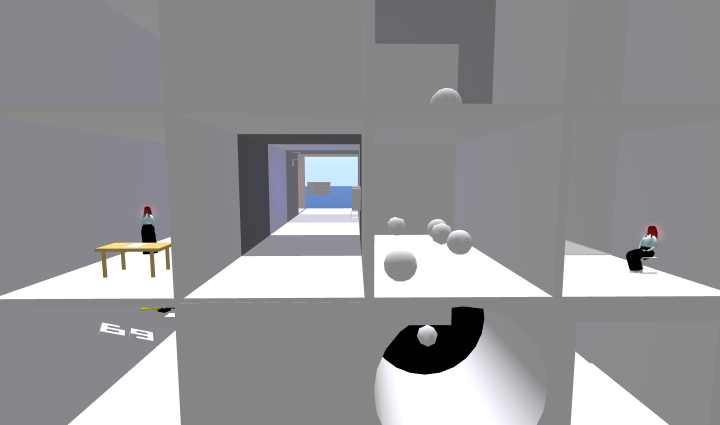
Selavy Oh has a reputation for artwork that makes unusual use of Second Life capabilities.  In CONSTRUCT, she has created what she describes as a performance, in which she built a cubicle every day for 75 days, forming a three-storied construction, a square of 25 cubes laid out at each one.  (She describes the process in her blog.)

Some of cubicles are static, with perhaps an image on the wall. In some cubes, things happen. Balls may drop to the floor and spill out of the building. Numerous blocks with the number "69" (for the 69th day?) fall up to the ceiling. You might fall through the floor. You might turn parts of the building invisible. You might find yourself ejected. There are two Selavy Oh bots, one named SelavyOh, the other OhSelavy; sit across from one of them, and you'll find yourself in a sync'ed animation in which one of you stands while the other sits, back and forth. One of the rooms has a chair that will give you a camera tour.

Not only do things happen in some of the rooms, but in a sense, the rooms themselves happen. They move. Stay in one place for a while, and eventually cubes change position as you stand. Return for a second visit, and the rooms will be in a completely different arrangement. Even their content seems to alter: you may find new rooms, while others will be nowhere to be found.

There is another level within CONSTRUCT. Some of the rooms present a question, all on the same model. "And what, for example, am I now remembering?" "And what, for example, am I now thinking?" "And what, for example, am I now seeing?" The last, undoubtedly the seed of the others, comes from Wittgenstein's Remarks on Colour:

What actually is the 'world of consciousness'?—That which is in my consciousness: what I am now seeing, hearing, feeling....—And what, for example, am I now seeing? The answer to that cannot be: "Well, all that" accompanied by a sweeping gesture.

Finally, CONSTRUCT presents various forms of self-representation. One cube contains a schematic model of CONSTRUCT itself, which (at least some of the times I went) showed your current position within the build. At other locations, you see the scripts operating the installation. The Selavy Oh bots are another form of self-reference, the constructor placing constructions of herself in her construction. One room contains a box listing artworks antecedent to CONSTRUCT, such as pieces by Sol LeWitt, Vladimir Tatlin, Bruce Nauman, and of course Marcel Duchamp (who named his alter ego Rrose Selavy). You can also pick up a mini-CONSTRUCT to take home with you, with the nine letters of CONSTRUCT switching about the face of a 3x3 box.

One might describe CONSTRUCT as a thinking machine, a machine that thinks, which one can watch as it ponders images, observes its own perceptions, making and unmaking connections unceasingly. To call it a "machine" is not a criticism. On the contrary, there is an significant history of art-machines, not least among them those created by Marcel Duchamp: "Bachelor Machines," optical illusion machines and many others.

CONSTRUCT is a highly self-aware installation, cognizant of its own transience and ongoing transformations, laying bare its own workings, self-aware without being self-conscious.  It is, one might say, a machine for making art -- that is making art -- with LSL scripts as its instruction manual and self-referential imagery as its illustrations.


Click on images to enlarge. [Post reconstructed from a draft after The Great Blogger Crash.]